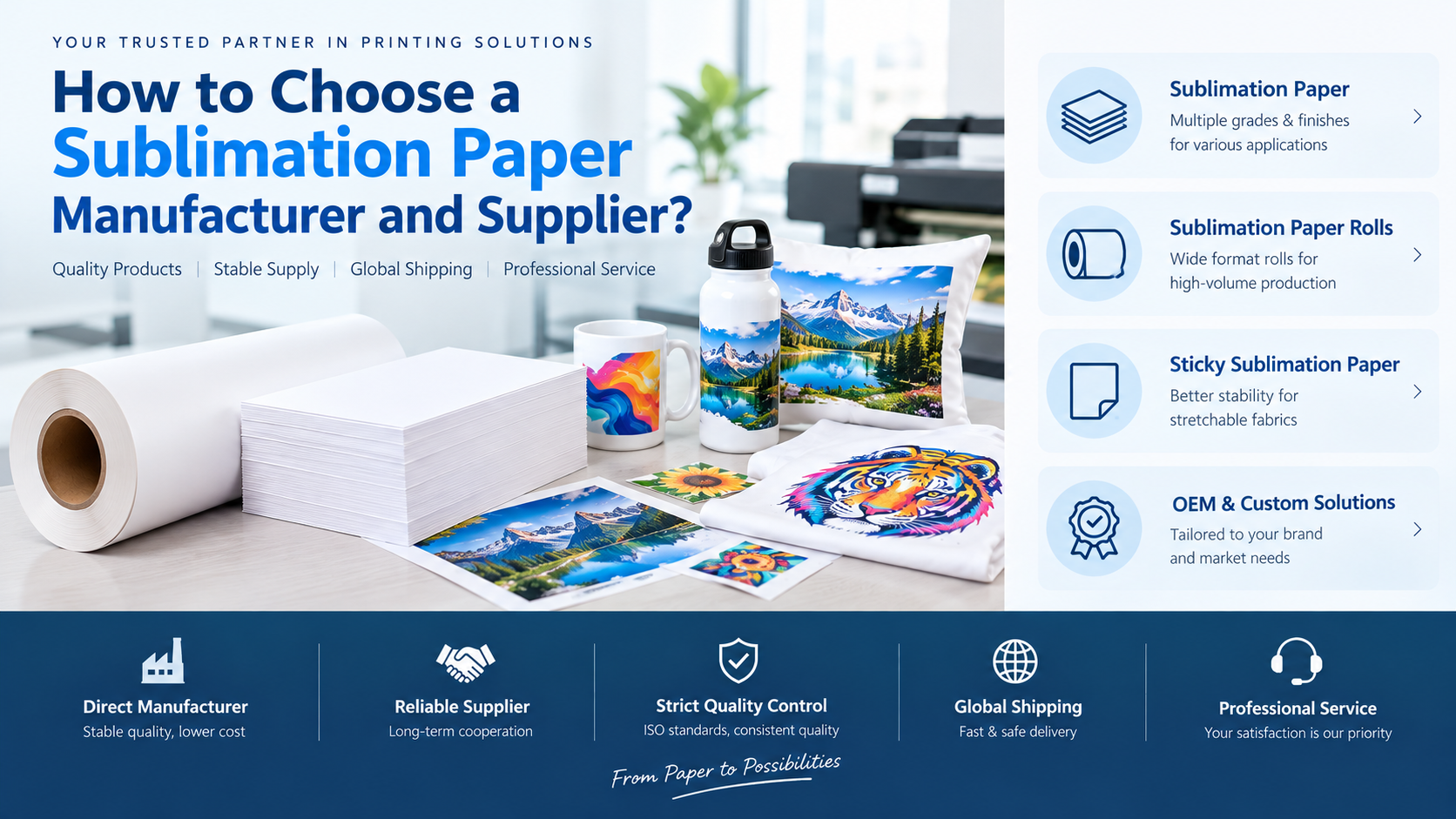
The most reliable way to evaluate a sublimation paper supplier is to match the paper grade to your production requirements, test it under real operating conditions, and confirm that the supplier can consistently provide the agreed specification.
What Should Buyers Check When Comparing Sublimation Paper?
Buyers should begin with the printing process, intended substrate, production speed, and required paper format. These factors help narrow down the product options before requesting quotations or samples.
- Basis weight (GSM): Whether the paper weight suits the printer, ink load, and transfer workflow.
- Coating technology: Whether the coating is designed for the intended sublimation printing requirements.
- Drying behavior: Whether printed sheets or rolls can be handled at the required production pace.
- Flatness and dimensional stability: Whether the paper feeds and transfers consistently under the actual operating conditions.
- Transfer performance: Whether the printed design transfers as required on the intended substrate.
- Supply capability: Whether the manufacturer can support the required format, order quantity, packaging, and repeat-order specifications.
A product description alone cannot confirm all these factors. Ask the sublimation paper manufacturer for the current technical data sheet and validate the grade with samples.
Explore Sublimation Paper Options
Review available grades and formats before requesting samples or a wholesale quotation.
Does Higher GSM Mean Better Sublimation Paper?

No. GSM measures the mass of paper per square meter; it does not independently determine transfer quality. A higher-weight paper may be suitable for one workflow, while a lighter grade may be more appropriate for another.
The correct choice depends on the printer, ink coverage, paper handling requirements, transfer process, and production speed.
When comparing sublimation paper grades, consider the following:
- Paper handling: Does the paper feed reliably through the intended printer?
- Ink load: Can the grade handle the amount of sublimation ink used in your artwork?
- Drying time: Can the paper be handled or processed at the pace required by your operation?
- Flatness: Does the paper remain sufficiently flat during printing and transfer?
- Transfer result: Does the final print meet the required color, detail, and consistency expectations?
Koalapaper lists different grades of sublimation paper, including 100 GSM, 105 GSM, 120 GSM, and 125 GSM options. These are examples of available product grades, not a universal ranking of quality. Confirm current availability and specifications directly before placing an order.
For buyers sourcing wholesale sublimation paper, the goal should be to select the grade that fits the application and production workflow rather than automatically choosing the highest GSM.
What Is the Difference Between Microporous and Swellable Sublimation Paper?
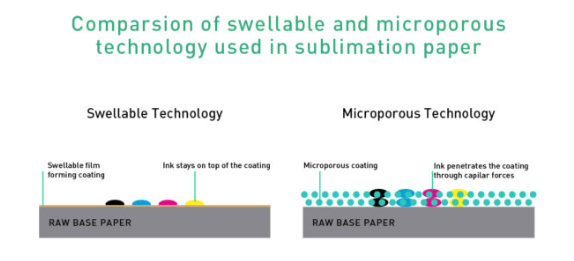
Microporous and swellable coatings are two coating approaches used in sublimation paper. Their ink-handling behavior can differ, so buyers should compare the actual product performance rather than assume that one coating type is always better.
Microporous sublimation paper
Microporous coatings use a porous structure to receive ink. Depending on the product formulation, this type of paper may be designed for quick ink uptake and drying.
It can be worth evaluating when the workflow requires frequent printing, rapid handling, or higher production throughput. However, drying time and transfer performance still depend on the specific grade, ink load, environmental conditions, and printer settings.
Ask the supplier how the product was evaluated and whether the stated drying performance matches your intended operating conditions.
Swellable sublimation paper
Swellable coatings absorb ink through a coating that expands as it takes up liquid. Some traditional sublimation paper products use this type of coating.
The relevant purchasing question is not simply which coating sounds more advanced. Instead, consider the production speed, ink coverage, handling requirements, and transfer results that your customers need.
How should buyers compare the two?
Use the same printer, ink, artwork, and operating conditions to compare samples. Record drying behavior, print quality, handling, and the final transfer result. If the supplier recommends different settings for different grades, follow the documented instructions for each product.
This comparison helps importers and distributors choose products based on measurable suitability rather than a broad coating label.
Explore microporous and swellable sublimation paper options.
Why Do Drying Speed and Flatness Matter in Production?
Drying behavior and paper flatness can affect how smoothly a sublimation printing workflow operates. They should be evaluated together with printer settings, ink coverage, room conditions, and downstream transfer requirements.
Drying speed and production handling
If printed paper needs to be handled, stacked, or transferred soon after printing, drying behavior becomes an important selection criterion.
A paper grade that dries adequately with a low-coverage design may behave differently when printing dense graphics or large areas of color. Humidity, temperature, ink formulation, and printer settings can also affect the result.
When evaluating a sublimation paper supplier, ask for the conditions behind any drying-time claim. Then run a test using representative artwork and the same handling process used in production.
Flatness and paper feeding
Paper curl or uneven handling can interrupt printing and make alignment more difficult. The extent of the problem depends on the base paper, coating, storage conditions, humidity, and printer setup.
For sheet-fed printing, check whether sheets remain flat enough for reliable feeding and handling. For roll-to-roll production, examine roll condition, tension, feeding behavior, and consistency throughout the roll.
Buyers should also store samples according to the supplier’s instructions before testing. A sample exposed to unsuitable storage conditions may not represent the product’s expected performance.
When Should You Choose Sticky Sublimation Paper?
Sticky, or tacky, sublimation paper is designed to adhere lightly to compatible fabric during the heat-transfer process. This can help reduce paper movement and image ghosting when the paper shifts during transfer.
It is especially worth evaluating for workflows involving slippery or stretchable polyester fabrics, such as selected sportswear and performance garments. Suitability still depends on the specific paper, fabric, printer, ink, and transfer settings.
Before purchasing, confirm:
- Whether the tack level suits the intended fabric and process.
- Whether the paper releases cleanly after transfer under the recommended conditions.
- Which sheet sizes or roll formats are available.
- Which printers and sublimation inks are supported.
- Whether the product is suitable for the buyer’s production line and expected order volume.
Sticky sublimation paper should not be treated as a universal replacement for standard sublimation paper. It is a specialized option for applications where paper movement during transfer is a meaningful production concern.
For example, buyers can review sticky sublimation paper for stretchable polyester fabrics and request samples to check suitability for their own workflow.
Printing Stretchable or Slippery Fabrics?
Evaluate a tacky paper grade if paper movement during transfer is a concern in your workflow.
Should You Buy Sublimation Paper Sheets or Rolls?
The choice between sheets and rolls depends on the printer format, production volume, job size, and handling process. Neither format is automatically more economical for every buyer.
Sheet sublimation paper
Sheets may be convenient for compatible desktop printers, smaller print jobs, sampling, and operations that process individual designs.
When evaluating sheet products, confirm the available dimensions, sheets per pack, packaging, and printer compatibility. Do not assume that every sheet size works with every desktop printer.
Roll sublimation paper
Rolls are commonly considered for wide-format and continuous printing workflows. Buyers should compare roll width, length, core and winding requirements where applicable, and the specifications of their printer.
For high-volume operations, the amount of usable paper per roll and consistency across repeat orders can be as important as the initial purchase price.
If you are sourcing sublimation paper rolls for wide-format printing, provide the printer model, required width, estimated consumption, and production needs when requesting a quotation.
How Can You Evaluate a Sublimation Paper Manufacturer Before Ordering in Bulk?
A suitable sublimation paper manufacturer should be able to explain its product specifications, clarify compatibility requirements, and provide a clear process for sample evaluation and order confirmation.
| Evaluation area | Questions to ask |
|---|---|
| Product specifications | What are the confirmed GSM, coating type, dimensions, and tolerances for the selected grade? |
| Printing compatibility | Which printer and ink systems have been specified or tested for this product? |
| Sample testing | Can the buyer evaluate samples using the intended printer and transfer workflow? |
| Production and quality | How are product specifications checked and maintained between batches? |
| Customization | Are custom sizes, sheet or roll formats, or packaging options available for the required order? |
| Supply and logistics | What are the current MOQ, lead time, packaging details, and shipping arrangements? |
| Documentation | Which technical data sheets, quality documents, or test records can be provided for the specific product? |
A manufacturer and a trading supplier may offer different service models. Buyers should clarify who manufactures the product, who handles quality issues, and which party is responsible for specifications, documentation, and repeat-order consistency.
Avoid making a sourcing decision based on broad claims such as “premium quality” or “factory direct” alone. Ask for details that can be checked against the sample, technical data sheet, and purchase order.
How Should Wholesale Buyers Test Sublimation Paper Samples?
Sample testing is one of the most useful steps before approving a bulk order. It helps confirm whether the paper works with the buyer’s equipment and provides a reference for future supply.
- Confirm the grade. Record the product code, GSM, coating type, size, and roll or sheet format.
- Use the intended equipment. Test with the printer, sublimation ink, and settings planned for production.
- Print representative artwork. Include both lighter designs and higher-coverage graphics where relevant.
- Evaluate handling. Check drying behavior, feeding, flatness, and any problems during routine handling.
- Complete the transfer. Use the intended substrate and the supplier’s recommended process.
- Review the result. Assess color, detail, alignment, and consistency against the application’s acceptance criteria.
- Record the approved sample. Keep the product details and test conditions for future orders.
A successful sample test does not automatically validate every size, grade, or production batch. Keep the approved specification clear and confirm how any changes will be communicated before repeat orders.
What Information Should You Send to a Sublimation Paper Supplier?
A detailed inquiry helps the supplier identify a relevant product grade and prepare a more accurate quotation.
- Application: Apparel, sportswear, home textiles, hard substrates with a compatible coating, or another intended use.
- Printer and ink: Printer model, printing system, and sublimation ink type.
- Product format: Sheets or rolls, required dimensions, and any format restrictions.
- Production requirements: Estimated consumption, expected order quantity, and desired production speed.
- Performance priorities: Drying behavior, flatness, tack, ink load, or other criteria that matter to the workflow.
- Packaging requirements: Bulk packaging, retail packs, or private-label requirements.
- Destination market: Country of delivery and any documentation requirements that apply to the transaction.
If you are comparing multiple suppliers, send the same specification to each one. This makes quotations easier to compare and reduces the risk of evaluating products with different specifications.
How Can Koalapaper Support Your Sublimation Paper Sourcing?
Koalapaper’s sublimation paper range includes different grades and formats for different printing requirements, including sheet products, industrial rolls, and sticky sublimation paper. Buyers should confirm the current product specifications, compatibility, availability, and commercial terms for the exact grade they intend to source.
For wholesalers, importers, distributors, and commercial printing businesses, the next step is to match the intended application to a product specification, request samples, and validate the paper under real operating conditions.
Looking for a Sublimation Paper Manufacturer or Supplier?
Share your printer model, required format, target application, and estimated order quantity to start a product discussion.
The right specification, verified sample, and clear supply agreement provide a stronger foundation for long-term sourcing than price comparison alone.