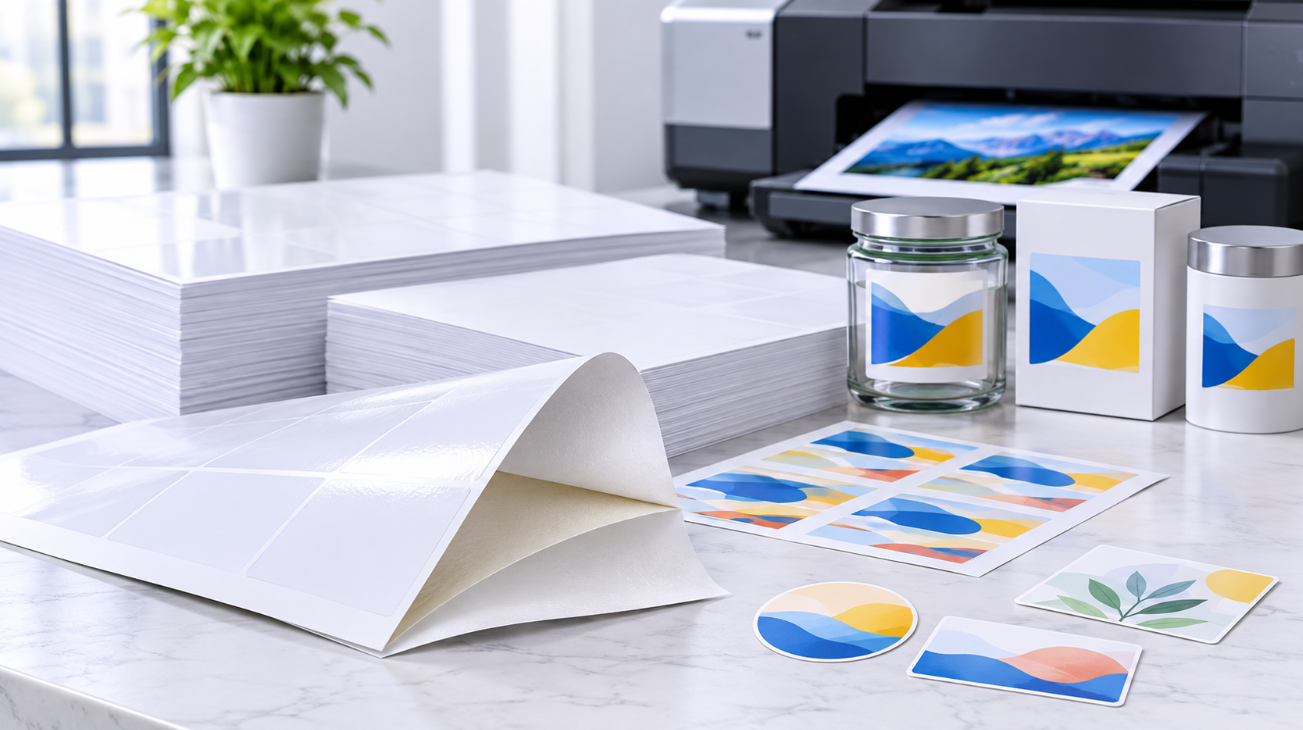
Inkjet paper labels are self-adhesive label materials with a paper facestock and a printable surface coating designed for compatible inkjet printers. They typically consist of three main components: the face paper, adhesive layer, and release liner.
Unlike plain paper, inkjet label paper is engineered to receive ink and support label applications. The surface coating helps control ink absorption and image quality, while the adhesive layer allows the printed label to be applied to a suitable surface.
For wholesalers and distributors, inkjet paper labels are a practical product category for customers who need printable labels with a paper appearance, flexible designs, and a cost-conscious material option.
1. What Are Inkjet Paper Labels?
Common applications include product and packaging labels, bottle and jar labels for suitable indoor applications, mailing and address labels, office identification and organization labels, sealing stickers, promotional labels, and personalized labels for small businesses.
The exact performance depends on the paper coating, ink system, adhesive, liner, and application environment. Buyers should evaluate the complete label construction rather than judging a product by its face paper alone.
Koalapaper offers several types of inkjet label paper, including glossy, matte, semi-gloss, and metallic paper options.
2. What Are the Main Types of Inkjet Paper Labels?
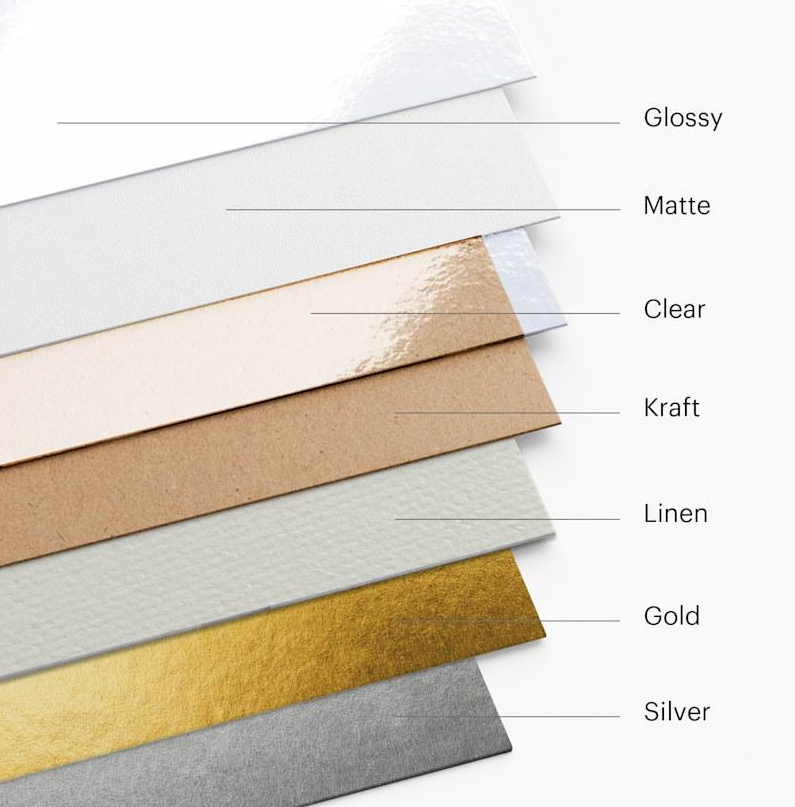
The main types of inkjet paper labels differ in surface appearance, print presentation, and suitable applications. Choosing the right finish helps distributors match products to different customer needs.
Glossy inkjet paper labels
Glossy inkjet paper labels have a smooth, reflective surface that can make printed colors and images look vivid. They are suitable for applications where visual impact and photographic-style printing are important.
- Product packaging labels
- Promotional stickers
- Colorful product identification labels
- Photo-style labels and decorative designs
Koalapaper lists high-gloss photo paper label options in its product range. The published specifications include 115 and 135 g/m² face-paper options for listed models.
Matte inkjet paper labels
Matte inkjet paper labels have a low-reflection surface, creating a softer and less glossy appearance. They can be a suitable choice for product information, office labels, packaging, and designs that prioritize readability.
- Reduced surface glare
- A clean, understated appearance
- Suitability for text-heavy label designs
- A paper-like finish for packaging
Koalapaper lists matte inkjet paper label options with 108 and 128 g/m² face-paper specifications for listed models.
Semi-gloss inkjet paper labels
Semi-gloss paper labels offer a middle ground between glossy and matte finishes. They provide some surface sheen without the stronger reflection of a high-gloss finish. This finish may be worth considering for customers who want a balanced appearance for product labels, packaging, and general-purpose printing.
Metallic paper labels
Metallic paper labels use a special surface appearance to create a more distinctive visual effect. Koalapaper’s listed paper label range includes metallic silver and metallic gold silky paper options.
They may be suitable for premium-looking packaging, gift and decorative labels, brand identification, and promotional projects. Metallic materials may have different printing requirements from standard glossy or matte paper. Buyers should confirm the compatible ink and printer system for the exact model before ordering.
Buyer tip: Request samples of each finish and print the same artwork on all of them. Comparing the same design makes it easier to evaluate color appearance, readability, surface reflection, and suitability for your target market.
3. How Do Face Paper, Adhesive, and Release Liner Affect Label Performance?
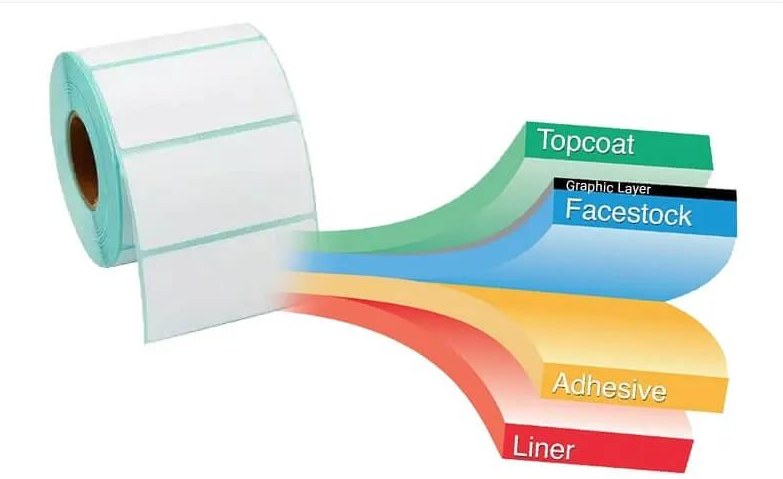
An inkjet paper label is a layered material. The face paper, adhesive, and release liner each affect printing, converting, application, and storage.
| Component | Main function | What buyers should evaluate |
|---|---|---|
| Face paper | Receives ink and provides the visible label surface | Paper weight, finish, coating, print quality |
| Adhesive | Bonds the label to the target surface | Adhesive type, initial tack, final adhesion, removability |
| Release liner | Protects the adhesive before application and supports label handling | Liner weight, stiffness, release performance, flatness |
Face paper and ink-receiving coating
The face paper determines the label’s visible appearance and contributes to its stiffness and handling characteristics. Its coating affects how ink is absorbed and how printed details appear.
A glossy coating may be selected for colorful graphics, while a matte coating may be more suitable for text-heavy designs. Metallic paper provides a different visual effect and may require additional compatibility testing.
Adhesive selection
The adhesive determines how the label bonds to the application surface. Koalapaper lists hot-melt glue and water-based glue options for its inkjet paper label range.
Buyers should consider the material of the application surface, whether it is smooth or curved, whether permanent or removable adhesion is needed, the expected storage and application temperature, and possible exposure to moisture, oil, or other substances.
A label that adheres well to a clean paper box may behave differently on glass, plastic, or a coated container. Always test the adhesive on the actual application surface.
Release liner
The release liner protects the adhesive and makes the label easier to peel and apply. Its stiffness and flatness can also influence sheet feeding and converting performance. For wholesale buyers, liner consistency matters because unstable sheets can create problems during printing, cutting, peeling, or automated handling.
4. Are Inkjet Paper Labels Compatible with Dye and Pigment Ink?
Inkjet paper label compatibility depends on the coating formulation and the specific printer and ink combination. Not every paper label supports every ink system.
Koalapaper’s published specifications list dye ink compatibility and partial pigment ink compatibility for several paper label models. The metallic silver and gold options also list additional printing technologies for certain models. Buyers should confirm the exact model before making a compatibility claim.
Before bulk purchasing, check whether the label is designed for dye ink, pigment ink, or both; which printer models have been tested; whether the selected printer media setting produces the expected result; whether the ink dries properly; and whether fine text, barcodes, and small graphics print clearly.
For distributors supplying different printer users, it is useful to offer clear compatibility information on product packaging or specification sheets.
Do not assume that all inkjet label papers work with every desktop or large-format printer. A sample test using the customer’s own equipment is the safest way to confirm performance.
5. Are Inkjet Paper Labels Waterproof?
Standard paper labels should not automatically be described as waterproof. Their resistance to water depends on the face paper, coating, ink, adhesive, and any additional protective layer.
For dry indoor applications, paper labels may be an economical and practical choice. For products exposed to frequent water contact, outdoor weather, or demanding handling conditions, buyers should carefully assess whether a paper label is suitable.
If the application requires greater moisture or tear resistance, a compatible film label may be a better material to evaluate.
| Requirement | Material to consider |
|---|---|
| Indoor packaging and product information | Inkjet paper labels |
| Colorful product labels for dry environments | Glossy or semi-gloss paper labels |
| Text-focused labels with less reflection | Matte paper labels |
| Premium decorative appearance | Metallic paper labels |
| Higher moisture or tear resistance | Suitable PP or PET film labels |
The table is a material-selection starting point, not a performance guarantee. Actual water resistance should be confirmed through product specifications and testing.
For applications where a film facestock is more appropriate, see Koalapaper’s inkjet vinyl label range.
6. What Should Wholesale Buyers Check Before Ordering Inkjet Paper Labels?
Wholesale buyers should evaluate the complete product specification, not only the face-paper weight or unit price. A suitable label must meet the printing, application, converting, and supply requirements of the target market.
| Purchasing factor | Questions to confirm |
|---|---|
| Face paper | Glossy, matte, semi-gloss, or metallic? |
| Paper weight | Which GSM options are available? |
| Ink compatibility | Dye, pigment, or specific printer models? |
| Adhesive | Hot melt or water-based? Permanent or removable? |
| Release liner | What material, weight, and stiffness? |
| Sheet format | A4, A3, Letter, or custom size? |
| Roll format | Are roll formats available for the required application? |
| Cutting | Can the supplier provide custom shapes or die-cut formats? |
| Packaging | Is moisture-protective packaging available? |
| Order requirements | What are the MOQ, lead time, and customization options? |
Koalapaper’s product page lists A4, A3, and other formats, as well as customized size options for certain models. It also lists different adhesive and ink compatibility options across the product range. Confirm availability against the exact SKU before placing an order.
Test samples before confirming a bulk order
- Print a design containing solid colors, gradients, small text, and barcodes.
- Check ink drying and smudging.
- Test sheet feeding in the intended printer.
- Apply labels to the actual packaging or product surface.
- Check peeling and application convenience.
- Evaluate adhesion after the required storage or handling period.
- Compare samples from different batches when repeat supply is important.
This process helps buyers identify potential issues before committing to a large order.
7. Inkjet Paper Labels vs. Inkjet Vinyl Labels: Which Should You Choose?
Inkjet paper labels and inkjet vinyl labels use different face materials, so they serve different application needs.
Paper labels use a paper facestock with a suitable inkjet coating. Vinyl or other film labels use a synthetic film facestock with a printable surface treatment. Both may be supplied as self-adhesive materials, but their moisture resistance, tear resistance, appearance, and handling characteristics can differ.
| Comparison factor | Inkjet paper labels | Inkjet vinyl or film labels |
|---|---|---|
| Face material | Coated paper | Synthetic film such as PP or PET |
| Appearance | Paper-based finish | Film-based finish, including transparent options |
| Typical strengths | Print appearance, paper feel, economical positioning | Flexibility, tear resistance, and options for moisture-exposed uses |
| Moisture resistance | Depends on coating and protection | Depends on film, ink, and construction |
| Typical applications | Indoor packaging, office labels, product information | Selected packaging, product labels, and applications needing film properties |
| Buyer priority | Finish, paper weight, adhesive, print quality | Film type, transparency, durability, ink compatibility |
For many dry indoor applications, paper labels can offer a practical balance between print quality and material cost. Where the application requires a film facestock or greater resistance to moisture and tearing, a suitable film label may be more appropriate.
The right decision depends on the customer’s actual use conditions, not simply on whether one material is generally considered more durable.
8. How Do You Choose a Reliable Inkjet Paper Label Supplier?
A reliable inkjet paper label supplier should provide clear specifications, consistent material quality, sample support, and practical customization options.
Check product range and technical information
Ask for a product specification sheet covering face paper, coating, GSM, adhesive, liner, printer compatibility, and available formats. A supplier should be able to explain the differences between glossy, matte, semi-gloss, and metallic products.
Review quality control
Ask how the supplier checks coating uniformity, paper weight, sheet flatness, ink absorption, adhesive performance, and cutting accuracy. If your business depends on repeat orders, batch consistency should be part of the supplier evaluation.
Confirm customization capabilities
For distributors and private-label buyers, customization may include sheet dimensions, roll widths, adhesive options, packaging, and branding. Confirm which options are available for the selected material rather than assuming every specification can be combined.
Request samples and test them
Samples allow buyers to check printing and application performance with their own printers and packaging materials. This is particularly important when the labels will be resold to customers with different equipment.
Compare the full supply proposition
Unit price is important, but it should be considered alongside MOQ, production lead time, packaging, communication, and after-sales support.
A dependable inkjet paper label manufacturer should help buyers match a product specification to a real application and support consistent supply over time.
9. Why Source Inkjet Paper Labels from Koalapaper?
Koalapaper offers a range of inkjet paper labels for distributors, wholesalers, brand owners, and commercial printing businesses.
- High-gloss photo paper labels
- Matte inkjet paper labels
- Semi-gloss inkjet paper labels
- Metallic silver and metallic gold silky paper labels
- Different face-paper weights and adhesive options
- Standard and customized sheet formats
Koalapaper’s product information also lists hot-melt and water-based adhesive options, along with dye and partial pigment ink compatibility for selected models. Specific specifications should be confirmed for each SKU.
If you are sourcing wholesale inkjet paper labels, prepare your target finish, GSM, printer and ink type, adhesive requirement, sheet size, and estimated order quantity. This helps the supplier recommend a suitable product and arrange sample testing.
Looking for an inkjet paper label supplier? Contact Koalapaper to discuss paper label specifications, samples, and wholesale requirements.
Frequently Asked Questions
1. What are inkjet paper labels made of?
Inkjet paper labels generally consist of three layers: a printable paper facestock, an adhesive layer, and a release liner. The paper surface is coated to receive ink from compatible inkjet printers.
2. What is the difference between glossy and matte inkjet paper labels?
Glossy labels have a reflective surface that can make colors and images appear vivid. Matte labels have a lower-reflection surface and are often selected for text-focused designs and a softer appearance.
3. Can inkjet paper labels be used with pigment ink?
Some models support pigment ink, while others are designed primarily for dye ink. Compatibility depends on the coating and product model. Confirm the specification and test the label with the intended printer.
4. Are inkjet paper labels waterproof?
Not all paper labels are waterproof. Water resistance depends on the paper coating, ink, adhesive, and any protective finishing layer. Test the finished label under the conditions of its intended application.
5. Can inkjet paper labels be customized?
Many suppliers offer customization such as sheet size, roll width, adhesive selection, and die-cut formats. Available options and minimum order quantities depend on the product and supplier.
6. What should wholesalers consider when buying inkjet paper labels?
Wholesalers should compare paper finish, GSM, ink compatibility, adhesive, release liner, dimensions, packaging, MOQ, lead time, and batch consistency. Sample testing is recommended before bulk orders.