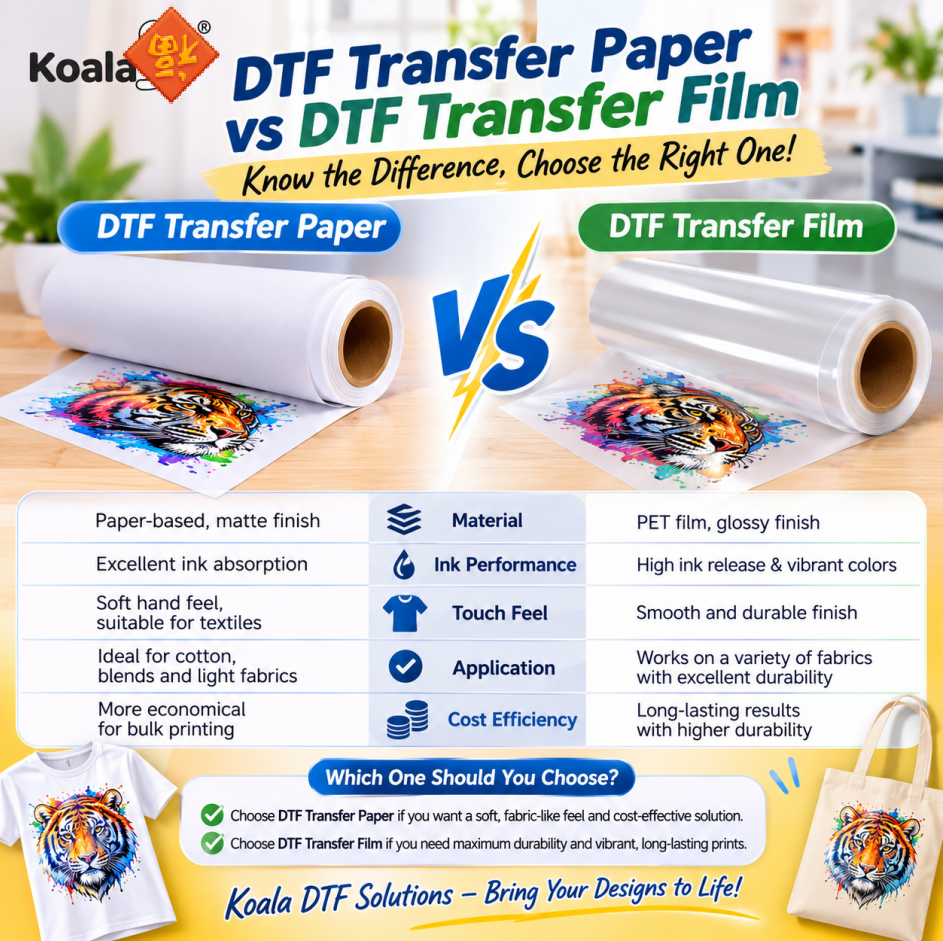
Direct-to-Film (DTF) printing has become an important process for producing customized apparel, bags, and other fabric products. Traditionally, the process uses PET-based DTF transfer film as the printing and transfer carrier. However, paper-based DTF transfer media offers another material option for businesses looking to explore alternative transfer substrates.
For DTF transfer suppliers, wholesalers, and printing businesses, understanding the difference between paper-based DTF transfer paper and conventional PET film is important when evaluating product performance, production workflows, and market opportunities.
The main difference is the carrier material: conventional DTF transfer film uses a PET-based substrate, while paper-based DTF transfer media uses a paper-based substrate with a specially developed coating. Both are designed to support the DTF printing and heat-transfer process, but their handling characteristics, material properties, and environmental positioning may differ.
1. What Is the Difference Between DTF Transfer Paper and DTF Transfer Film?
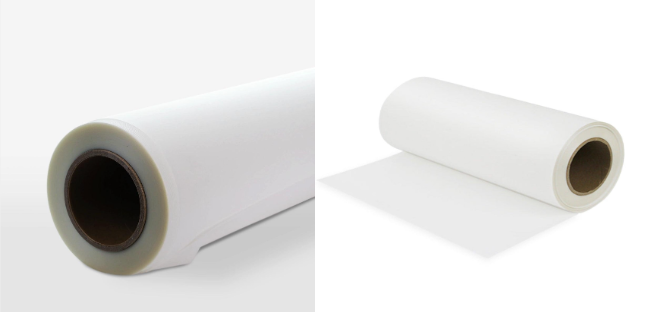
DTF transfer paper and conventional DTF transfer film are transfer media used in Direct-to-Film printing. Their main difference lies in the carrier substrate and its material construction.
Traditional DTF transfer film generally uses a PET carrier with a release coating. Paper-based DTF transfer media uses a paper-based carrier with a specially formulated coating designed for the DTF workflow.
| Comparison factor | Paper-Based DTF Transfer Paper | Conventional PET DTF Transfer Film |
|---|---|---|
| Main substrate | Paper-based material | PET film |
| Surface treatment | Specially developed coating | Release coating |
| Material appearance | Paper-based, generally opaque | Usually transparent |
| Printing process | Designed for DTF printing | Established DTF printing process |
| Powder application | Hot-melt adhesive powder | Hot-melt adhesive powder |
| Heat transfer | Requires compatible heat-press settings | Requires compatible heat-press settings |
| Environmental positioning | Potential for paper-based recyclability, depending on coating and local systems | Plastic-based carrier |
| Main evaluation points | Coating stability, ink absorption, powder adhesion, transfer results | Release performance, coating uniformity, dimensional stability |
For wholesalers and distributors, the key consideration is not simply whether the material is paper or film. It is whether the transfer media can deliver consistent printing, powder application, transfer performance, and production efficiency for the target customer.
2. How Does Paper-Based DTF Transfer Paper Work?
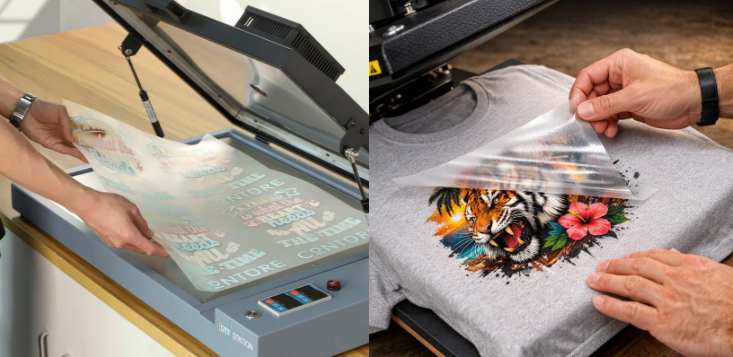
Paper-based DTF transfer media follows the main stages of a conventional DTF production workflow: printing, powder application, curing, heat transfer, and peeling.
Step 1: Print the design
The printer applies the image to the printable side of the transfer media. In a typical DTF workflow, the design is printed using CMYK inks and white ink according to the printer’s configuration. The media must be compatible with the printer, ink system, and selected print settings.
Step 2: Apply hot-melt adhesive powder
After printing, hot-melt adhesive powder is applied to the printed surface. The powder adheres to the wet ink areas and forms the bonding layer used during heat transfer. Even powder distribution is important. Excessive or uneven powder may affect the final transfer appearance and adhesion.
Step 3: Cure the adhesive powder
The printed media passes through a suitable curing process to melt the adhesive powder. Curing conditions depend on the powder formulation, equipment, and media specifications. The objective is to achieve a suitable adhesive layer without damaging the printed image or transfer substrate.
Step 4: Heat press onto the fabric
The cured transfer is positioned on the target material and applied using a heat press. Temperature, pressure, and pressing time should follow the recommended parameters for the media, adhesive powder, and fabric.
Step 5: Peel the carrier
After pressing, the carrier is peeled according to the specified hot-peel or cold-peel procedure. The transfer should be checked for adhesion, edge definition, color appearance, and resistance to normal handling.
For transfer suppliers: A paper-based DTF product should be evaluated through the complete workflow, not just by checking whether it can pass through a printer.
3. What Are the Key Advantages of Paper-Based DTF Transfer Media?
Paper-based DTF transfer media is developed as an alternative carrier material for DTF production. Its potential benefits include paper-based material construction, printing stability, ink handling, and flexible application requirements.
Paper-based substrate and environmental positioning
A paper-based substrate provides an alternative to conventional plastic film carriers. The Koala product information describes its transfer media as paper-based, with a bio-based biodegradable coating and recyclable material positioning.
For businesses looking to expand their product portfolio with alternative transfer materials, this can provide a new product story for customers interested in material innovation and more sustainable printing options.
However, recyclability and biodegradability depend on the complete material construction, coating formulation, local waste-management infrastructure, and applicable certification. Buyers should request supporting documentation before making environmental claims in their own marketing.
Ink absorption and printing stability
According to the supplied Koala product information, the coating is designed to provide ink absorption and support stable printing. The product is also described as having no ink backflow and no oil seepage, with the aim of reducing printing-related issues during production.
For commercial users, these properties should be evaluated through actual printer tests, including solid-color coverage, white ink printing, fine details, and continuous production runs.
Adhesion and transfer performance
The transfer substrate, ink layer, and hot-melt adhesive powder must work together to achieve a consistent transfer result. Koala product information highlights strong ink absorption, powder adhesion, and compatibility with different fabric applications.
For buyers, the most useful evaluation is to test whether the powder distributes evenly, whether the transfer edges remain clean, and whether the printed design adheres properly after pressing.
Hot-peel and cold-peel application options
The supplied product information describes compatibility with both hot-peel and cold-peel workflows. This may give printing businesses flexibility when working with different production habits and transfer requirements. However, buyers should confirm the applicable peel procedure and settings for the exact product and adhesive powder combination.
4. How Does Paper-Based DTF Transfer Paper Compare with PET Film in Production?
Paper-based DTF transfer media and conventional PET film should be compared through actual production performance, including feeding, printing, powder application, curing, and heat transfer.
| Production factor | Paper-Based DTF Transfer Paper | Conventional PET DTF Transfer Film |
|---|---|---|
| Material handling | Evaluate stiffness, flatness, and feeding stability | Evaluate film tension, flatness, and feeding stability |
| Ink performance | Test absorption, backflow, and image definition | Test ink spreading, coating performance, and image definition |
| Powder adhesion | Check powder distribution and bonding | Check powder distribution and bonding |
| Curing stability | Confirm coating and substrate tolerance | Confirm film and coating tolerance |
| Transfer result | Check adhesion, color, and edge definition | Check adhesion, color, and edge definition |
| Production compatibility | Verify printer and workflow suitability | Verify printer and workflow suitability |
Neither material should be assumed to perform better in every production environment.
PET film has an established position in DTF printing and is familiar to many printing businesses. Paper-based transfer media provides an alternative substrate, but its performance must be assessed using the specific printer, ink, powder, curing equipment, and heat press.
For wholesale buyers, sample testing should include continuous printing rather than just a single test sheet. This helps identify issues such as feeding instability, coating variation, powder inconsistency, and transfer defects.
5. Which Fabrics Can Be Used with Paper-Based DTF Transfer Paper?
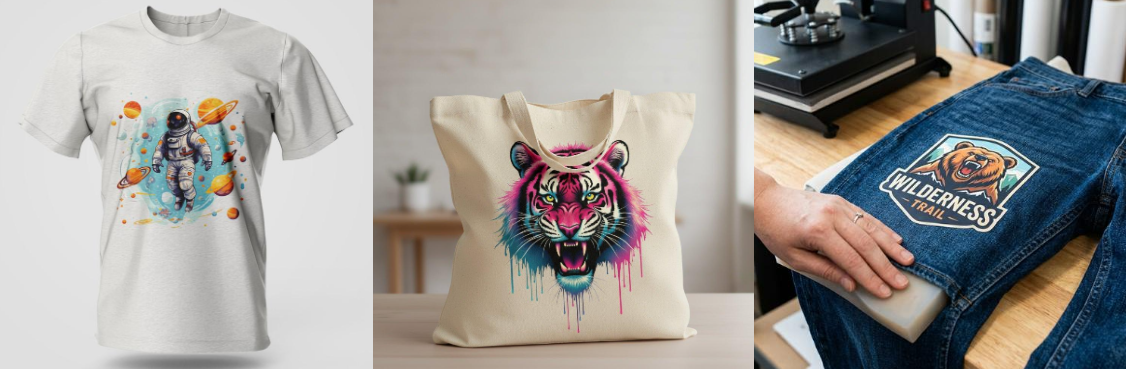
Paper-based DTF transfer media can be used for different fabric applications when the transfer media, adhesive powder, and heat-press conditions are properly matched.
- Cotton T-shirts and apparel
- Polyester garments
- Denim and canvas products
- Hoodies and sportswear
- Tote bags and fabric accessories
- Selected leather and leather-like materials
The actual suitability depends on fabric composition, surface treatment, heat tolerance, and adhesive performance.
Suggested transfer parameter references
The following values are taken from the Koala product information supplied for this article. They should be treated as starting references for sample testing, not universal production settings.
| Fabric type | Temperature | Pressure | Time |
|---|---|---|---|
| Cotton, linen, polyester, and other common fabrics | 130–160°C | 3–6 kg/cm² | 6–15 seconds |
| Denim, canvas, and other heavy fabrics | 190°C | 3–6 kg/cm² | 6–15 seconds |
| Leather and leather-like materials | Below 100°C | 3–6 kg/cm² | 6–15 seconds |
Important: The actual temperature, pressure, and pressing time must be confirmed through testing. Fabric heat tolerance, adhesive powder, heat-press calibration, and peel conditions can all affect the result. In particular, leather and leather-like materials require careful testing to avoid surface damage.
6. What Should DTF Transfer Suppliers Test Before Bulk Purchasing?
For wholesalers and distributors, product evaluation should cover material quality, printing performance, transfer results, and consistency across production batches.
| Test item | What to evaluate | Why it matters |
|---|---|---|
| Surface quality | Coating uniformity, scratches, defects | Helps maintain consistent printing |
| Printer feeding | Flatness, feeding stability, media handling | Reduces production interruptions |
| Ink performance | Absorption, backflow, smearing, image clarity | Affects print quality |
| Powder application | Adhesion and distribution uniformity | Influences transfer bonding |
| Curing | Coating and substrate stability | Helps prevent process defects |
| Transfer performance | Adhesion, edge definition, color appearance | Determines final product quality |
| Peeling | Hot-peel or cold-peel behavior | Affects production workflow |
| Batch consistency | Comparison between samples and bulk production | Supports repeat orders |
A reliable sample evaluation should use the same printer, ink, powder, curing equipment, fabric, and heat press conditions that will be used in actual production.
For suppliers serving multiple markets, it is also useful to collect customer feedback from different fabric categories and production environments.
7. What Should Wholesalers Consider When Sourcing DTF Transfer Paper?
DTF transfer suppliers should evaluate more than the material’s unit price. Product stability, technical support, packaging, supply capacity, and environmental documentation can all influence its commercial value.
Confirm the material specification
Ask the manufacturer for information about the paper substrate, coating formulation, printable surface, thickness, roll dimensions, and compatible printing systems.
Review production performance
Request samples and evaluate the complete printing and transfer workflow. Pay particular attention to continuous printer feeding, powder adhesion, curing, and peeling performance.
Check environmental documentation
If the product is marketed as recyclable or biodegradable, ask for supporting technical documents and applicable test reports. Environmental claims should match the actual material construction and relevant disposal conditions.
Evaluate packaging and storage
The supplied Koala product information recommends storing the material in a cool, dry place, with an indicated storage environment of 20–25°C and 40–60% relative humidity.
It also recommends keeping the product in its original packaging, resealing opened packages, and avoiding direct contact with floors or walls. These conditions should be followed according to the final product specification and local storage environment.
Consider long-term supply capability
For distributors and bulk buyers, consistent specifications and repeat-order stability are essential. Discuss MOQ, lead time, roll dimensions, packaging requirements, and technical support before confirming a supply agreement.
8. Why Consider Koala Paper-Based DTF Transfer Media?
Koala paper-based DTF transfer media is designed as an alternative to conventional PET-based transfer film.
According to the product information supplied, its key features include:
- Paper-based transfer substrate
- Bio-based biodegradable coating
- Recyclable material positioning
- Ink absorption designed for stable printing
- Powder adhesion and transfer performance
- Hot-peel and cold-peel workflow compatibility
- Applications across different fabric categories
For DTF transfer wholesalers, printing material distributors, and garment decoration businesses, this product offers an opportunity to evaluate a different carrier material within an established DTF production workflow.
Before introducing it to customers, businesses should test samples with their own printers, inks, powders, curing equipment, and heat presses. Product specifications and environmental claims should also be confirmed against the manufacturer’s latest technical documentation.
Looking for an alternative to conventional PET DTF transfer film? Contact Koala to discuss paper-based DTF transfer media, sample testing, and wholesale supply requirements.
Frequently Asked Questions
1. What is the difference between DTF transfer paper and DTF transfer film?
The main difference is the carrier substrate. Paper-based DTF transfer media uses a paper-based substrate with a specially developed coating, while conventional DTF transfer film generally uses a PET carrier with a release coating.
2. Can paper-based DTF transfer paper replace PET DTF film?
It may serve as an alternative in compatible DTF workflows. However, buyers should confirm printer feeding, ink compatibility, powder application, curing, peeling, and transfer results before switching production materials.
3. Does paper-based DTF transfer paper use the same printing process as PET film?
The general workflow is similar: printing, hot-melt powder application, curing, heat pressing, and peeling. Specific printer settings and processing parameters may differ by product.
4. Is paper-based DTF transfer paper recyclable?
The Koala product information describes the material as paper-based and recyclable, with a bio-based biodegradable coating. Actual recyclability depends on the complete construction, local recycling facilities, and supporting product documentation.
5. Can paper-based DTF transfer media be used on polyester and cotton?
It is intended for applications involving different fabric types, including cotton and polyester. The correct adhesive powder and heat-press settings must be tested for each fabric.
6. What should wholesalers test before ordering paper-based DTF transfer media?
Wholesalers should test printer feeding, ink absorption, powder adhesion, curing, transfer adhesion, peeling behavior, and batch consistency. Environmental claims and technical specifications should also be checked before resale.