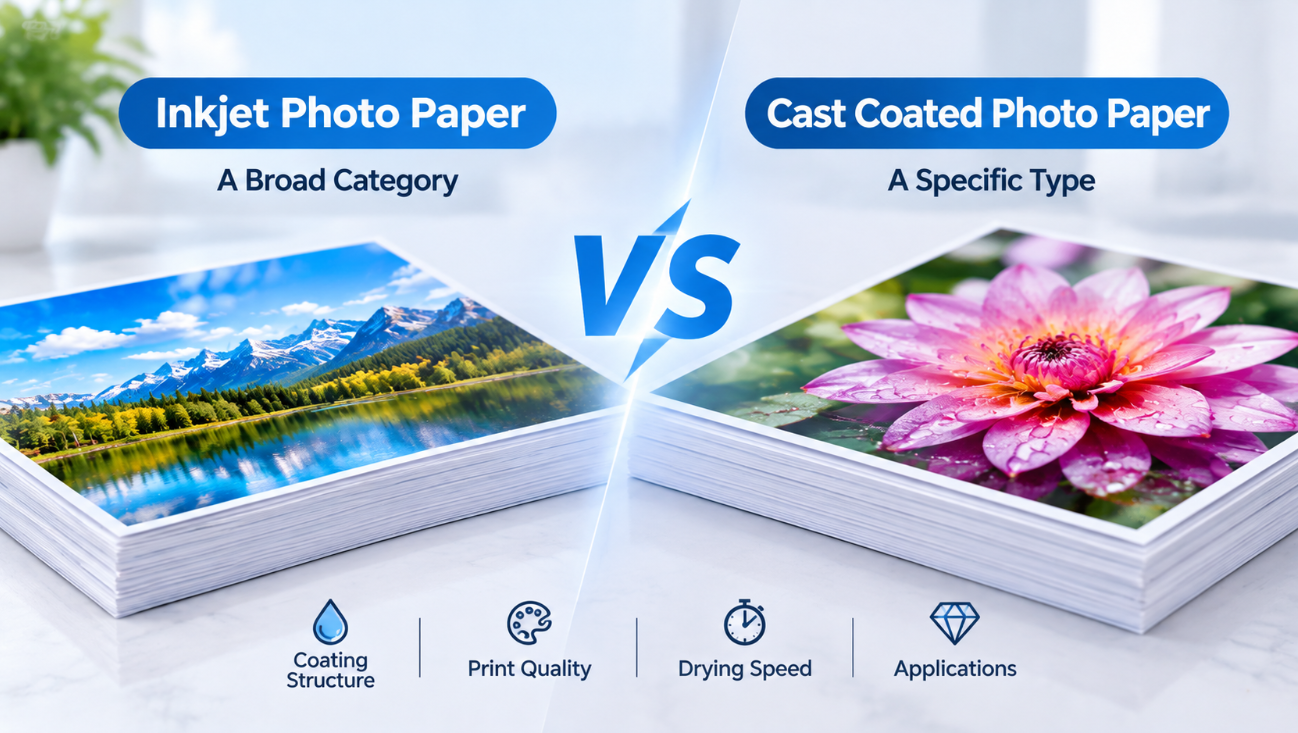
Inkjet photo paper is a broad category of printing media designed to produce photographic images with inkjet printers. Cast coated photo paper is one specific type of inkjet paper that uses a cast-coated image-receiving surface.
Although both can have a glossy finish and produce colorful images, they differ in coating structure, ink absorption, drying behavior, print performance, and typical applications.
For photo paper wholesalers, distributors, and printing businesses, understanding these differences is important when selecting products for different customer groups. In this article, we explain how cast coated photo paper works, how it compares with other inkjet photo papers, and what to evaluate before placing a bulk order.
1. What Is Inkjet Photo Paper?
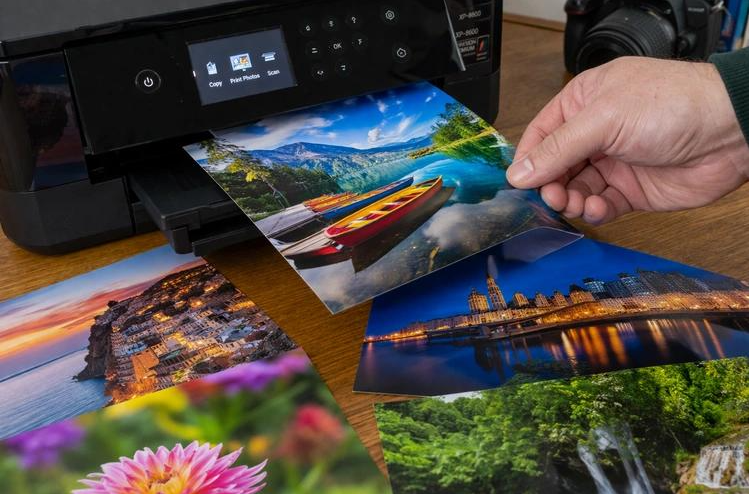
Inkjet photo paper is a specially coated printing medium designed to receive ink droplets and reproduce photographic images with good color, detail, and sharpness.
Unlike ordinary uncoated office paper, photo paper has an image-receiving coating that helps control how ink spreads, penetrates, and dries on the surface.
Depending on its construction and coating technology, inkjet photo paper can be divided into several types.
- Cast coated photo paper: Uses a cast-coated image-receiving layer to create a smooth, glossy surface.
- Swellable coated photo paper: Uses a polymer-based coating that absorbs liquid ink by swelling.
- Microporous photo paper: Uses a porous coating structure that allows ink to enter microscopic pores for rapid absorption.
- Other coated inkjet papers: Includes different glossy, semi-gloss, and matte products developed for specific printing requirements.
These categories are not simply different surface finishes. Their coating structures determine how ink interacts with the paper and can influence drying speed, moisture sensitivity, image quality, and compatibility with different ink systems.
It is also important to understand that glossy, semi-gloss, and matte describe surface appearance, while cast coated, swellable, and microporous describe coating technologies.
A glossy finish does not automatically mean a product is cast coated.
2. What Is Cast Coated Photo Paper?

Cast coated photo paper is an inkjet printing paper with a special image-receiving coating formed against a highly polished surface to achieve a smooth, glossy finish.
In a typical cast-coating process, the coating is applied to the paper base and pressed against a highly polished drum or surface while the coating is formed. This process helps create the characteristic smooth and glossy appearance.
According to the ISO classification of inkjet photo-grade media, cast-coated paper has a water-permeable image-receiving layer on the paper base. This is an important distinction from resin-coated (RC) photo paper, which has a water-resistant resin layer beneath the image-receiving coating.
How Does Cast Coated Photo Paper Receive Ink?
Cast coated photo paper receives ink through its image-receiving coating and the underlying paper structure.
When ink droplets land on the surface, the liquid components can penetrate into the coating and paper base. The exact absorption behavior depends on the coating formulation, paper base, and ink system.
This structure helps explain why cast coated photo paper can behave differently from RC-based photo paper, particularly when exposed to large amounts of ink or moisture.
Typical Characteristics of Cast Coated Photo Paper
Cast coated photo paper is commonly used as an economical glossy inkjet printing option.
Its typical characteristics may include:
- Smooth, glossy printable surface.
- Paper-based construction.
- Ink absorption through the coating and paper base.
- Different drying and moisture behavior from many RC-based products.
- A cost-conscious positioning for everyday photo printing.
However, cast coated photo paper is not automatically inferior or unsuitable for photo printing. Its performance should be evaluated according to the intended application, product formulation, and customer expectations.
3. Inkjet Photo Paper vs. Cast Coated Photo Paper What Are the Main Differences?
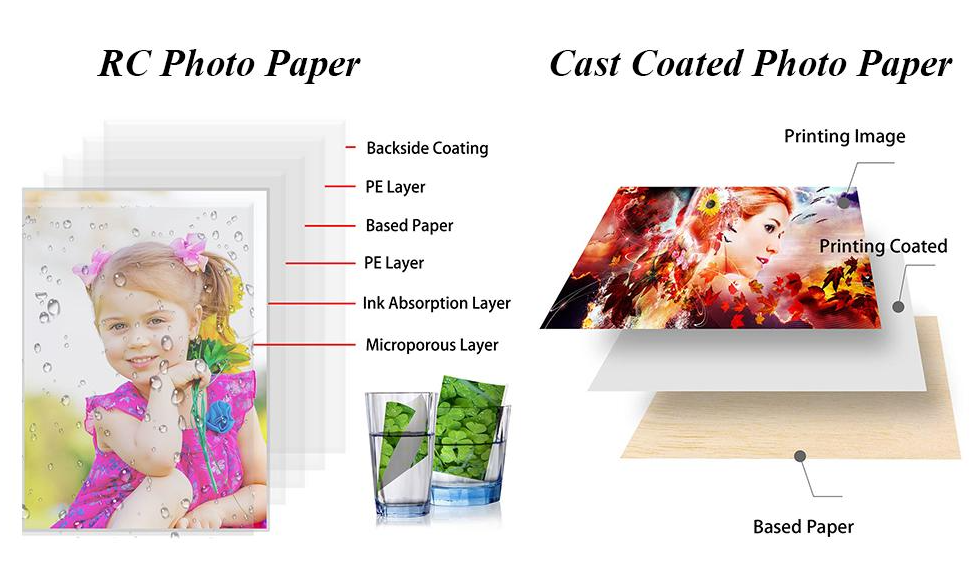
The main difference is that inkjet photo paper is a broad product category, while cast coated photo paper is one specific coating type within that category.
To make the comparison clearer, the following table compares cast coated photo paper with other common coated inkjet photo papers, especially swellable and microporous products.
| Comparison factor | Cast coated photo paper | Other coated inkjet photo papers |
|---|---|---|
| Product classification | A specific coating type | A broader group of coating technologies |
| Coating structure | Cast-formed image-receiving layer | May use polymer swelling or porous absorption |
| Paper base | Commonly paper-based and water-permeable | May use a paper base or an RC/barrier-coated base |
| Ink absorption | Ink can penetrate the coating and paper base | Depends on whether the coating is swellable or microporous |
| Drying behavior | Depends on formulation and paper absorption | Microporous types are generally designed for rapid ink uptake; swellable types may require longer drying |
| Surface finish | Commonly glossy | Glossy, lustre, semi-gloss, or matte |
| Moisture behavior | Paper base may be more affected by moisture | Depends on the base and coating construction |
| Typical positioning | Often cost-conscious everyday printing | Covers a wider range of photo and professional printing requirements |
The table describes general material differences, not guaranteed performance for every product. Actual results depend on the coating formulation, base paper, ink, printer settings, and environmental conditions.
3.1 Coating Structure and Ink Absorption
The coating structure is one of the most important differences between photo paper types.
Cast coated paper uses a water-permeable image-receiving layer. Other inkjet papers may use swellable polymer coatings or microporous coatings.
- Cast coated: Ink liquid components can penetrate the image-receiving coating and paper base.
- Swellable: The polymer coating absorbs liquid ink by swelling and helps hold colorants within the coating.
- Microporous: Small pores in the coating provide pathways for rapid ink absorption.
These different mechanisms affect the interaction between ink and paper.
3.2 Drying Speed
Drying speed is an important consideration for high-volume photo printing.
Microporous photo paper is generally designed for rapid ink uptake, making it suitable for workflows where prints need to be handled shortly after printing.
Swellable photo paper can require longer drying times because the coating absorbs ink through a swelling mechanism.
Cast coated paper has its own absorption characteristics. Its drying performance depends on the coating formulation, paper base, ink volume, and printing conditions.
For wholesalers supplying different printing markets, it is better to compare actual drying performance than to rely only on product descriptions such as “quick dry.”
3.3 Print Quality and Color Reproduction
Different coatings can produce different image characteristics.
Print quality depends on several factors:
- Ink droplet control and dot formation.
- Ink absorption and colorant distribution.
- Coating uniformity.
- Paper whiteness and surface smoothness.
- Printer resolution and color management.
A well-formulated cast coated paper can produce attractive glossy prints for everyday applications. Microporous and swellable photo papers can also deliver high-quality photographic output through different ink-receiving mechanisms.
There is no universal rule that one coating technology always produces better color. The best comparison is a controlled print test using the same image, printer, ink, and settings.
3.4 Moisture Resistance and Dimensional Stability
Paper-based cast coated media may be more sensitive to moisture because the paper base can absorb water.
Some other photo paper constructions use a resin-coated or barrier-coated base to reduce liquid penetration into the paper core.
However, a resin-coated base does not automatically make the entire printed product waterproof. The image-receiving coating, ink system, and product construction still matter.
For customers who need better moisture resistance, the complete material should be tested rather than judging performance from the coating name alone.
4. Which Type of Inkjet Photo Paper Is Suitable for Different Printing Applications?
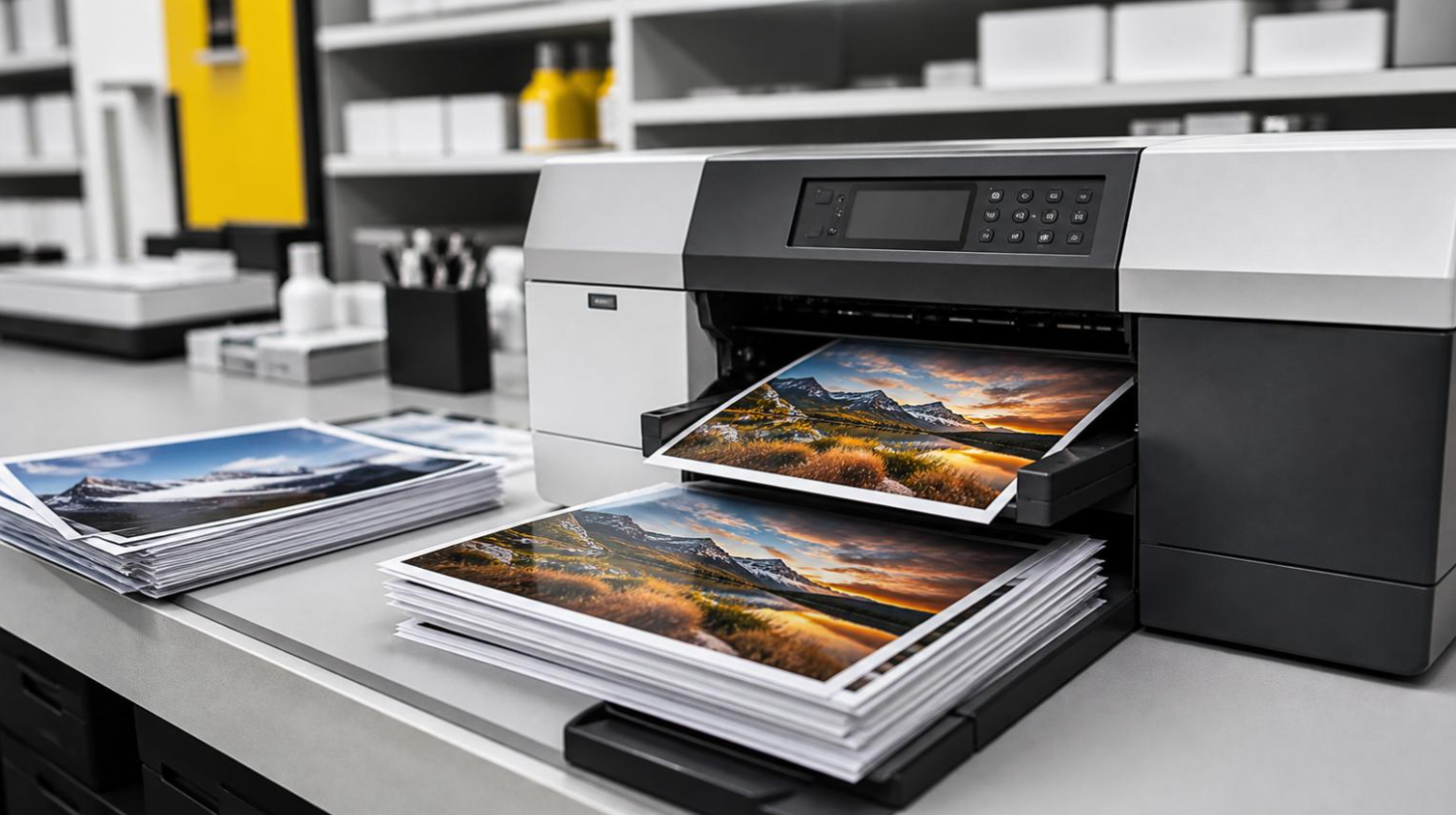
The most suitable photo paper depends on the intended print quality, production speed, price positioning, and end-user requirements.
Cast Coated Photo Paper for Everyday Printing
Cast coated photo paper can be considered for cost-conscious printing applications where a glossy appearance and attractive color output are required.
Potential applications include:
- Everyday photo prints.
- Personal photo printing.
- Promotional photo products.
- General-purpose photographic printing.
For these markets, buyers should evaluate print quality, drying behavior, paper flatness, and cost per print.
Microporous Photo Paper for Faster Printing Workflows
Microporous photo paper is often considered when rapid ink absorption and handling speed are important.
It can be useful for:
- Photo printing shops.
- High-volume printing environments.
- Retail photo printing services.
- Workflows requiring faster handling after printing.
Its suitability still depends on the ink and printer combination.
Swellable Photo Paper for Compatible Dye-Ink Systems
Swellable photo paper can be suitable for certain dye-based ink systems.
Its polymer coating absorbs liquid ink by swelling, helping retain colorants within the image-receiving layer. However, its drying time and environmental sensitivity should be considered.
The correct choice depends on the printer, ink formulation, and required output characteristics.
5. How Should Wholesale Buyers Compare Different Inkjet Photo Papers?
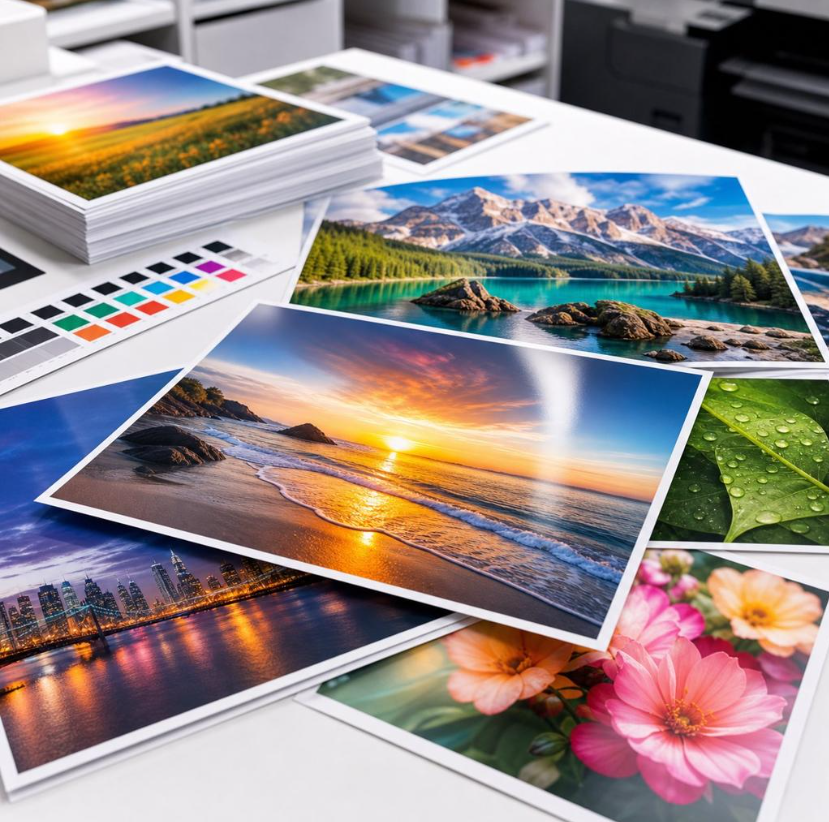
For wholesalers, distributors, and importers, comparing photo paper requires more than looking at the price per pack or the surface appearance.
The following factors can help evaluate products more systematically.
5.1 Check the Coating Technology
Ask whether the product uses a cast-coated, swellable, or microporous coating.
Do not assume that two glossy photo papers have the same construction or performance.
5.2 Confirm Printer and Ink Compatibility
Check the recommended printing technology and ink type.
Dye-based and pigment-based inks may interact differently with different coating formulations. Compatibility should be confirmed through product specifications and actual printing tests.
5.3 Compare Paper Weight and Thickness
GSM and thickness both influence how a photo paper feels and performs.
Buyers should compare:
- Grammage (GSM).
- Thickness.
- Paper stiffness.
- Flatness.
- Feeding performance.
A higher GSM does not always mean a proportionally thicker or stiffer paper.
5.4 Evaluate Drying and Handling Performance
For commercial printing customers, drying time can influence production efficiency.
Test the printed sheets under realistic conditions, including the intended print density, printer settings, and handling time.
5.5 Test the Product Before Bulk Purchasing
Before placing a large order, buyers should request samples and evaluate them using their own printers and inks.
A useful test checklist includes:
- Color reproduction.
- Image sharpness.
- Gloss consistency.
- Drying time.
- Ink smearing.
- Paper flatness after printing.
- Feeding stability.
- Performance under the intended storage conditions.
A consistent sample-testing process can help reduce product mismatch and complaints after bulk delivery.
6. What Should You Expect from a Reliable Inkjet Photo Paper Supplier?
A reliable photo paper supplier should provide more than a competitive quotation.
For distributors and importers, consistent product specifications, quality control, packaging options, and long-term supply capability are also important.
When evaluating an inkjet photo paper manufacturer, consider the following:
- Product range: Does the supplier offer different finishes, weights, and coating technologies?
- Specification consistency: Are GSM, thickness, size, and coating characteristics controlled?
- Sample support: Can you test samples before confirming a bulk order?
- Quality control: Does the manufacturer maintain consistent production and inspection procedures?
- Customization: Can the supplier discuss suitable sizes, packaging, and private-label requirements?
- Communication: Can the supplier provide clear technical information and after-sales support?
At Koalapaper, we focus on printing media and paper-based products for different printing and commercial applications.
If you are sourcing inkjet photo paper for distribution, retail, or printing operations, explore our instant printing photo paper and coated glossy paper product ranges.
Looking for a dependable photo paper supplier? Contact Koalapaper to discuss your target market, product specifications, and sample requirements.
Frequently Asked Questions
Is cast coated photo paper the same as inkjet photo paper?
No. Inkjet photo paper is a broad category of printing media, while cast coated photo paper is one specific type of inkjet paper with a cast-formed image-receiving coating.
What is the difference between cast coated and microporous photo paper?
Cast coated paper uses a water-permeable image-receiving coating, while microporous paper uses a porous coating structure that allows ink to enter microscopic pores. Their ink absorption and drying behavior can differ.
Does cast coated photo paper dry quickly?
Drying time depends on the coating formulation, paper base, ink type, and printing conditions. Buyers should evaluate the actual product rather than assuming all cast coated papers have the same drying speed.
Can cast coated photo paper be used with pigment ink?
Compatibility depends on the specific product formulation. Confirm the manufacturer’s specifications and test the paper with the intended printer and ink before bulk purchasing.
Is cast coated photo paper waterproof?
Not necessarily. Cast coated paper generally has a water-permeable image-receiving layer, and the paper base may absorb moisture. Its actual water resistance depends on the complete construction and printed ink system.
What should wholesalers check before purchasing inkjet photo paper?
Wholesalers should compare coating technology, printer and ink compatibility, GSM, thickness, surface finish, drying behavior, flatness, packaging, and sample-test results.