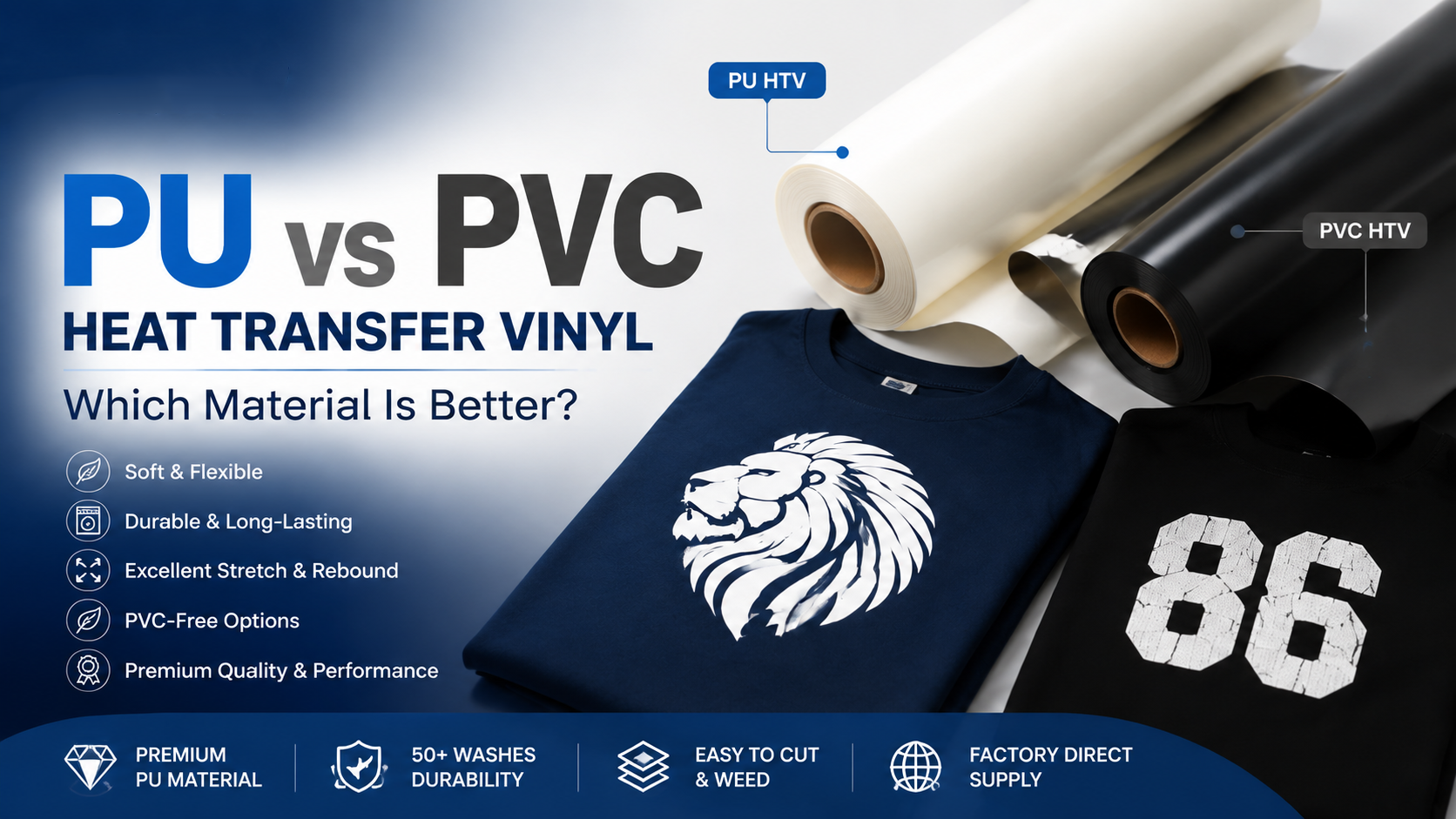
If you've ever purchased heat transfer vinyl for shirts, you've probably seen the two letters everywhere: PU and PVC HTV Vinyl.
Most beginners assume there's no difference. That's not true. Choosing the wrong material can lead to drastically different patterns; some designs are durable, while others may crack after a few washes.
As a heat transfer vinyl wholesale supplier for over 10 years, one of the most frequently asked questions is: "Should I choose PU or PVC HTV vinyl roll?"
In this guide, we at the heat transfer factory will provide a comprehensive overview of everything you need to know about PU and PVC heat transfer vinyl. You'll learn about the characteristics of each material, comparisons across 9 key dimensions, real-world test data, and—most importantly—which material is best suited for your specific project.
Disclaimer: Koala® Factory manufactures high-quality iron on PU heat transfer vinyl. This guide is based on materials science, industry data, and real-world testing. All comparisons are factual and repeatable.
What is Heat Transfer Vinyl for Shirt (HTV)?
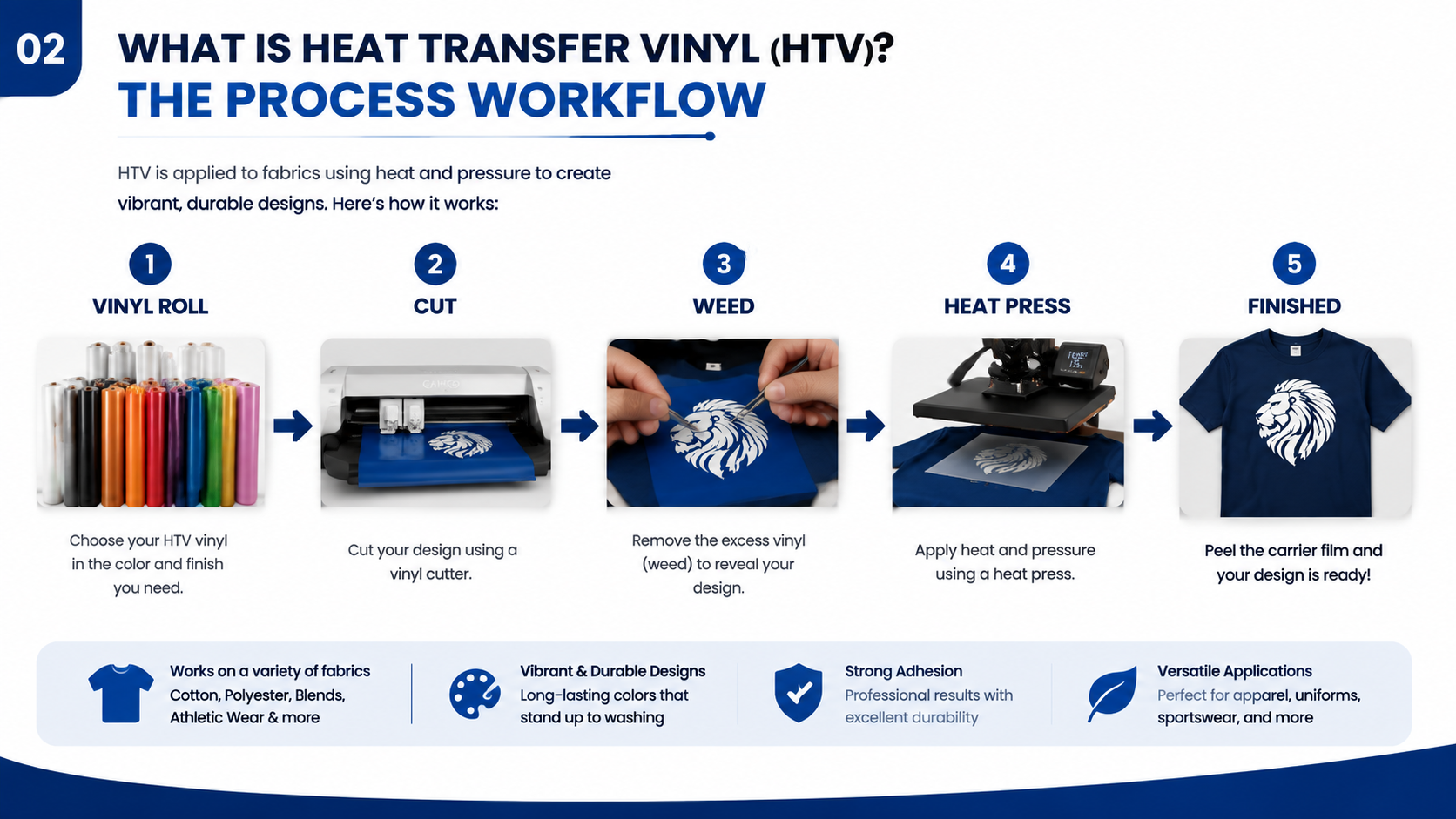
Heat Transfer Vinyl is a material with a polyurethane (PU) or polyvinyl chloride (PVC) base and a heat-activated adhesive coated on the back. The pattern is cut using a lettering machine (such as Cricut or Silhouette), excess material is removed, and then it is transferred onto the fabric using a heat press.
Heat Transfer T-Shirt Vinyl is one of the most popular methods in garment customization because it works with cotton, blends, and even some synthetic fabrics—something sublimation printing cannot achieve.
Global Heat Transfer Vinyl Market
The global HTV Heat Transfer Vinyl market is growing at a CAGR of 6.3% and is projected to reach $2.8 billion by 2033. PU Heat Transfer Vinyl dominates this market, expected to hold approximately 54% market share by 2026, thanks to its excellent stretchability, washability, and compatibility with a wide range of textile substrates.
Why this comparison is crucial
Choosing between PU and PVC is not just a matter of price. It also concerns:
- Comfort – How does it feel against the skin?
- Durability – How long is the designed lifespan?
- Application success rate – Will this material reliably fit your equipment?
- Customer satisfaction – Will your customers be satisfied with the final product?
What is pu vinyl heat transfer clothing?
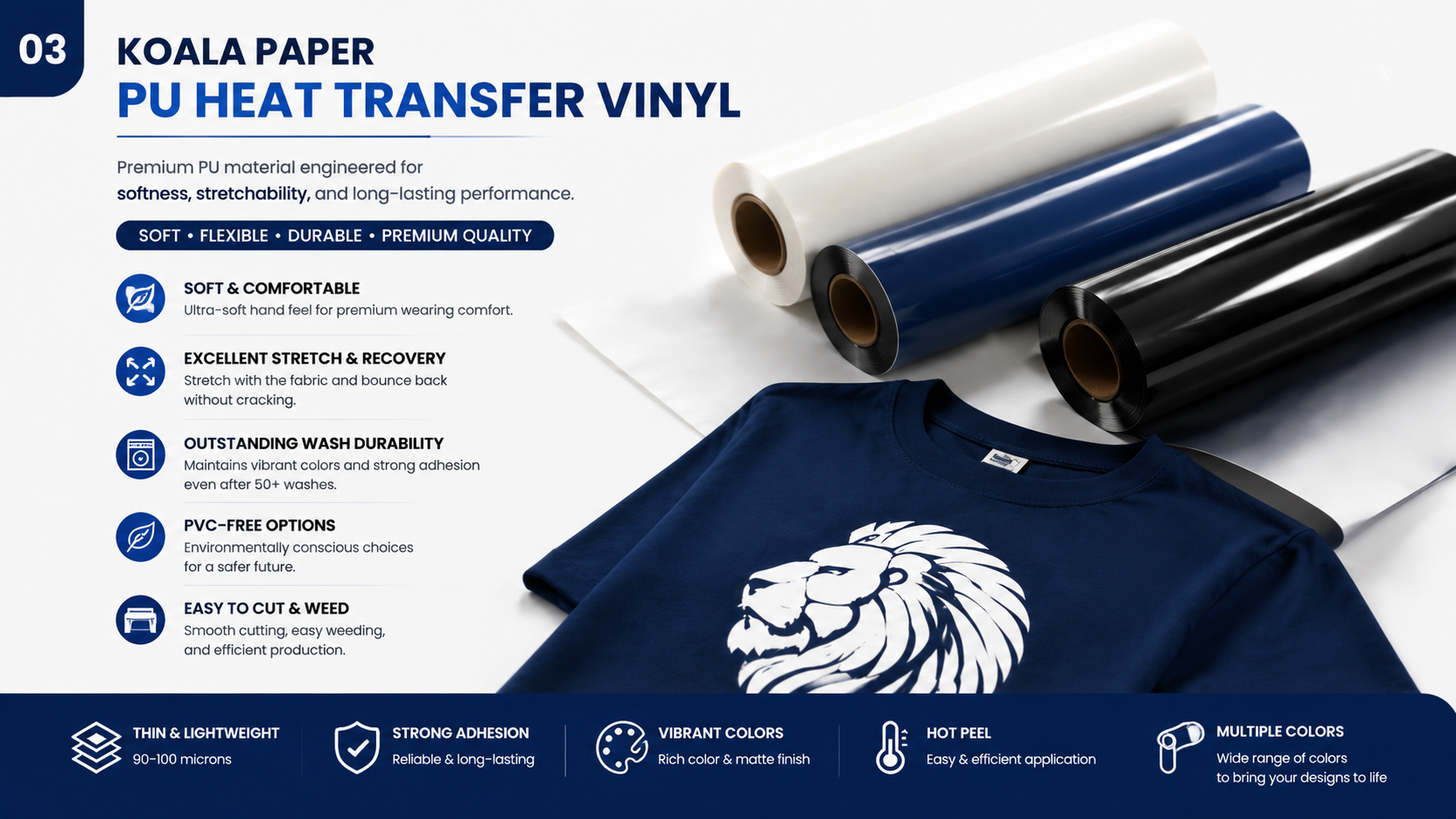
PU (polyurethane) heat transfer vinyl is a high-performance material made from polyurethane—a polymer known for its excellent elasticity, durability, and flexibility.
Chemical Composition
Polyurethane is a versatile polymer produced by the reaction of diisocyanates with polyols. The resulting material can be engineered to possess flexibility, durability, and resistance to abrasion, chemical corrosion, and weathering. It is these chemical properties that give PU vinyl heat transfer its superior performance.
Key Characteristics
| Property | PU HTV |
| Thickness | ~0.09–0.10 mm (90–100 microns) |
| Feel | Soft, matte finish |
| Elasticity | Excellent — >95% rebound |
| Stretch | Highly flexible and stretchable |
| Adhesive layer | Translucent with re-adhesive function |
| Wash durability | 50+ washes |
| Heat resistance | Stable up to 160°C |
| Cost | Higher (approx. 30% more than PVC) |
| Eco-friendliness | PVC-free, recyclable options available |
Detailed Advantages of PU Heat Transfer Vinyl Rolls
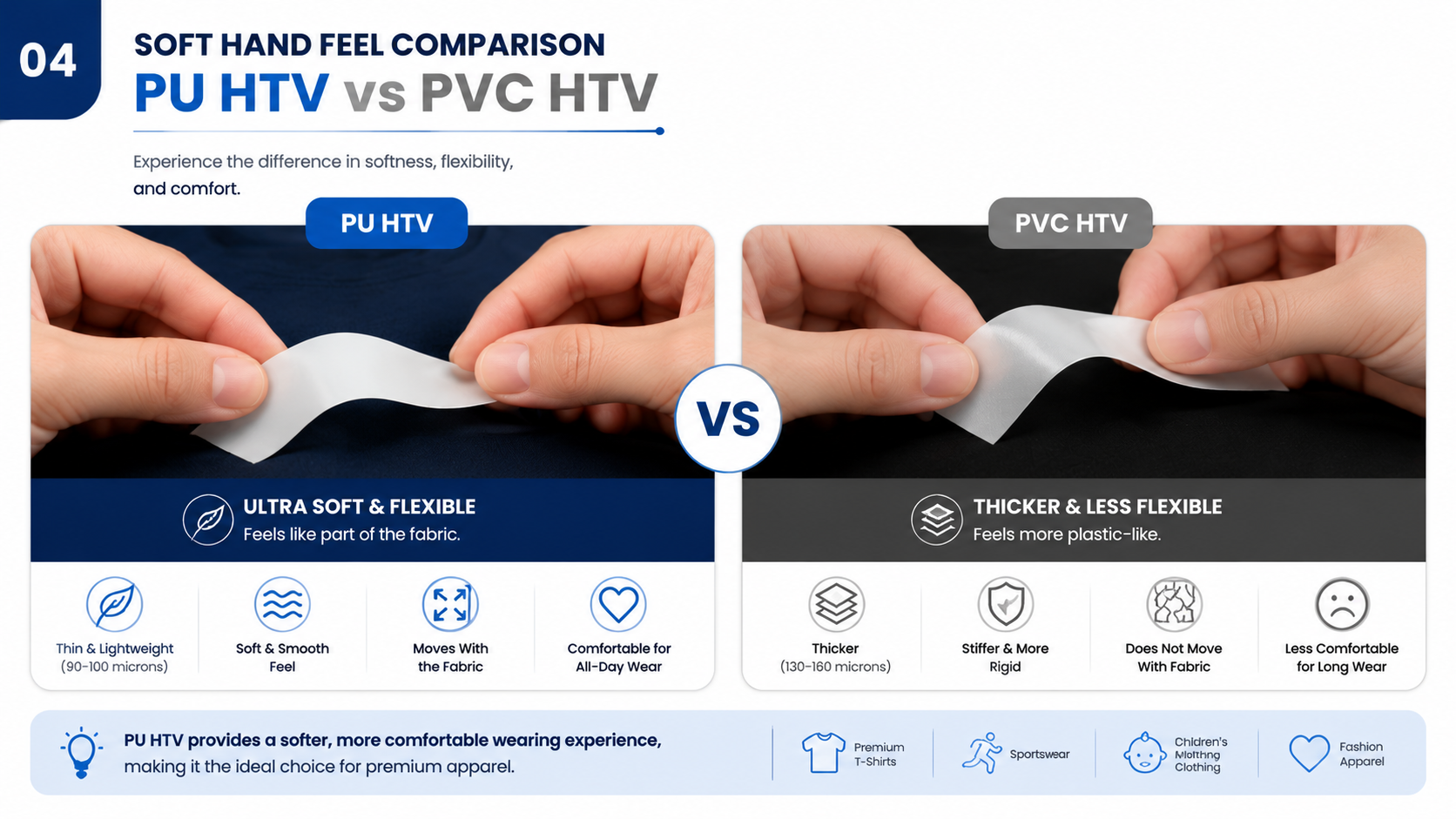
Soft Touch
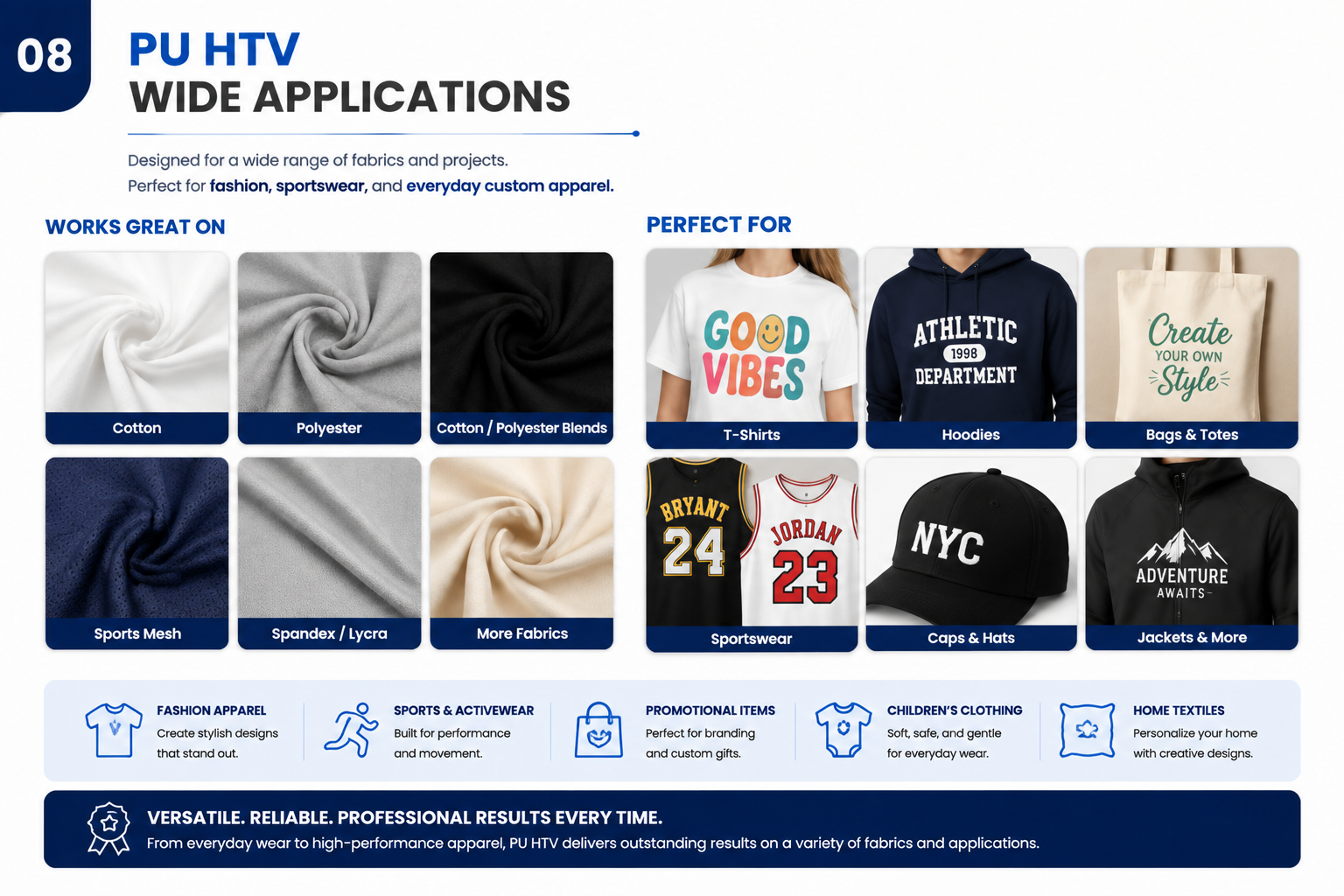
PU heat transfer vinyl for clothing is thinner and softer than PVC. With a thickness of approximately 90-100 microns, it has a soft, lightweight feel and conforms naturally to the fabric. Therefore, it is ideal for close-fitting garments such as everyday T-shirts, children's wear, and sportswear.
Excellent Elasticity and Resilience
PU material has exceptional elasticity, with a resilience rate exceeding 95%. This means the pattern can stretch with the fabric and return to its original shape after exercise without cracking or deforming. This is crucial for sportswear and performance clothing—the pattern moves with the athlete, rather than hindering their movement.
Superior Washability
PU heat transfer film is known for its excellent resistance to fading, peeling, and cracking. When used at the appropriate temperature, PU HTV Vinyl can withstand at least 50 washes. It can withstand rubbing, hand washing, and machine washing without fading. Independent testing shows that our PU heat transfer vinyl retains over 90% of its color intensity after 50 industrial washing cycles.
An Eco-Friendly Choice
PU materials are available in PVC-free formulations, avoiding the risk of releasing toxic chlorine gas during cutting or application. This makes PU a safer choice for children's clothing and laser cutting machines. Furthermore, PU waste is easier to process in industrial recycling systems.
Heat Peel-Off Process
PU heat transfer vinyl typically uses a heat peel-off process, which is faster and more efficient. The carrier film can be peeled off immediately after heat pressing, saving valuable production time.
Excellent Opacity
PU HTV vinyl offers excellent opacity on dark fabrics. The high pigment content ensures that even vibrant colors appear vivid against black or navy blue backgrounds.
Best Applications for PU HTV
| Application | Why PU Works |
| Sportswear & performance wear | Stretches with the body, excellent rebound, breathable |
| Everyday T-shirts and apparel | Soft hand feel, comfortable against skin, durable |
| Children's clothing | PVC-free options available, skin-safe, no toxic risks |
| Detailed designs | Thin material allows precise cutting and weeding |
| High-end retail products | Premium look and feel, matte finish |
| Athletic team uniforms | Withstands frequent washing and intense physical activity |
| Yoga and activewear | Moves with the body, does not crack at stress points |
| Workwear and corporate apparel | Professional appearance, long-lasting |
9 Key Differences Between PU and PVC Heat Transfer Vinyl
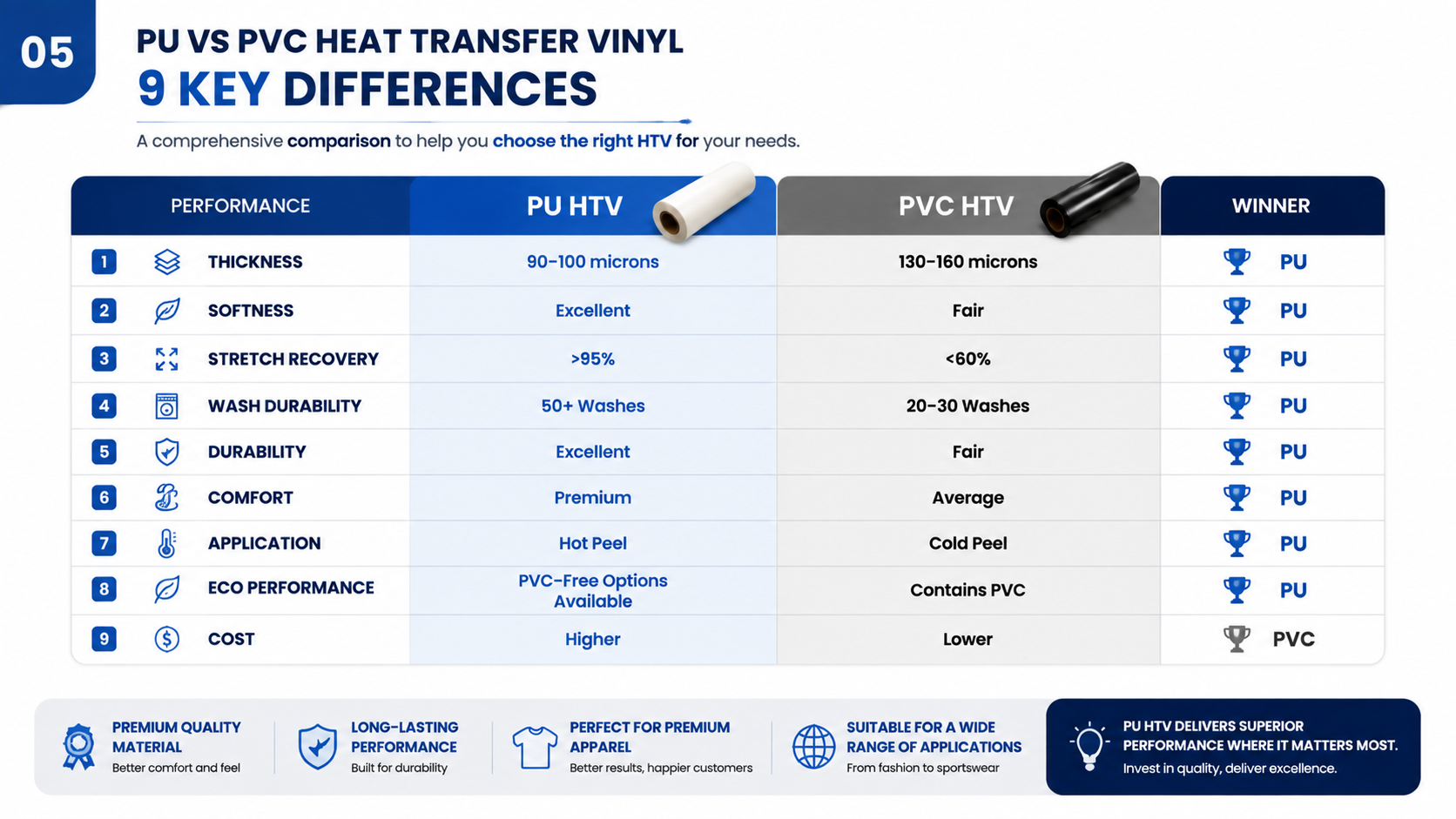
1.Thickness
| Thickness | PU:0.09–0.10 mm (90–100 microns) | PVC: 0.13–0.18 mm (130–180 microns) |
PU is approximately 40–50% thinner than PVC. This directly impacts comfort, flexibility, and the overall feel of the finished garment.
2.Hand Feel
PU: Soft and matte, feels like part of the fabric. The pattern stretches naturally with the garment, almost imperceptible.
PVC: Thicker and stiffer, with a noticeable plastic feel. The pattern is on the surface of the fabric, not integrated. The pattern is clearly visible when touching the garment.
3.Elasticity and Stretch
PU: High elasticity, with excellent stretch and resilience (>95%). Ideal for sportswear and stretch fabrics. The pattern stretches along with the fabric when stretched.
PVC: Limited stretch. The material cannot effectively return to its original shape, and long-term use may lead to deformation or cracking.
4.Washability
PU: Resistant to fading, peeling, and cracking. With proper use, it can withstand more than 50 washes. Independent testing confirms that after 50 industrial washes, the color retention rate is still above 90%.
PVC: May crack under repeated stress and washing. Poor long-term durability. Wear and tear typically occurs after 20-30 washes.
5.Adhesive Layer
PU: Semi-transparent, with reusable adhesive. This makes repositioning easier during application. If misplaced, the pattern can be adjusted before heat pressing.
PVC: Frosted/matte appearance, not reusable adhesive. Once applied, adjustments are more difficult. Accurate positioning is required on the first attempt.
6.Application Method
PU: Typically heat-peeled – faster and more efficient. The backing paper can be peeled off immediately after heat pressing.
PVC: Typically requires cold peeling or more stringent temperature control. The material must cool before peeling, increasing production time.
7.Temperature Resistance
PU: Maximum temperature resistance 160°C. Greater tolerance to temperature fluctuations.
PVC: Maximum temperature resistance 140°C. More prone to charring or melting at higher temperatures.
8.Environmental Impact
PU: PVC-free and recyclable options are available. More suitable for children's clothing. Does not release toxic gases.
PVC: Contains chlorine, which releases toxic gases when burned. Plasticizers may leach out. Recycling options are limited.
9.Cost
| PU | PVC | |
| Relative cost | Higher | Lower (30% less) |
| Best for | Quality-focused, professional applications | Budget-conscious, high-volume production |
Quick Comparison Table
| Feature | PU HTV | PVC HTV |
| Thickness | 0.09–0.10 mm | 0.13–0.18 mm |
| Feel | Soft, matte | Thicker, rigid |
| Elasticity | Excellent (>95% rebound) | Limited |
| Wash durability | 50+ washes | 20–30 washes |
| Adhesive | Translucent, re-adhesive | Frosted, no re-adhesive |
| Application | Hot peel (faster) | Cold peel (slower) |
| Temperature tolerance | Up to 160°C | Up to 140°C |
| Environmental | PVC-free, recyclable | Contains chlorine |
| Cost | Higher | ~30% lower |
| Best for | Sportswear, apparel, quality products | Budget projects, simple designs |
Real-world application testing: PU vs. PVC HTV heat transfer vinyl head-to-head
We conducted a series of tests to compare the performance of PU and PVC heat transfer vinyl under real-world application conditions. The test results are as follows.
Test 1: Wash Durability (50 Cycles)
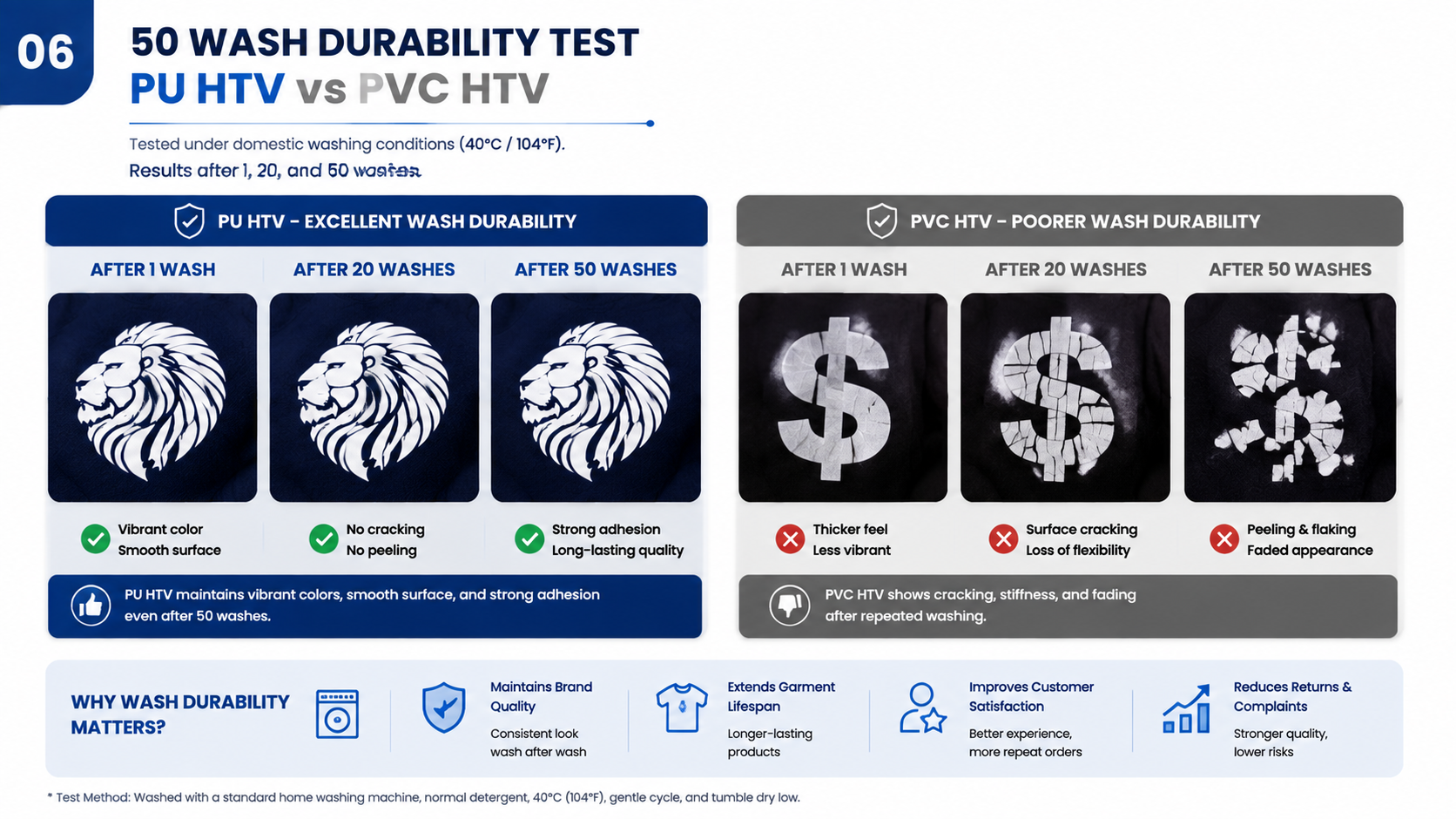
| Metric | PU HTV | PVC HTV |
| Color retention after 50 washes | 92% | 68% |
| Cracking after 50 washes | None | Visible cracks on 30% of designs |
| Peeling after 50 washes | None | Edges lifting on 15% of designs |
| Overall condition | Like new | Significant wear |
Conclusion: PU HTV significantly outperforms PVC HTV in long-term wash durability.
Test 2: Stretch and Rebound
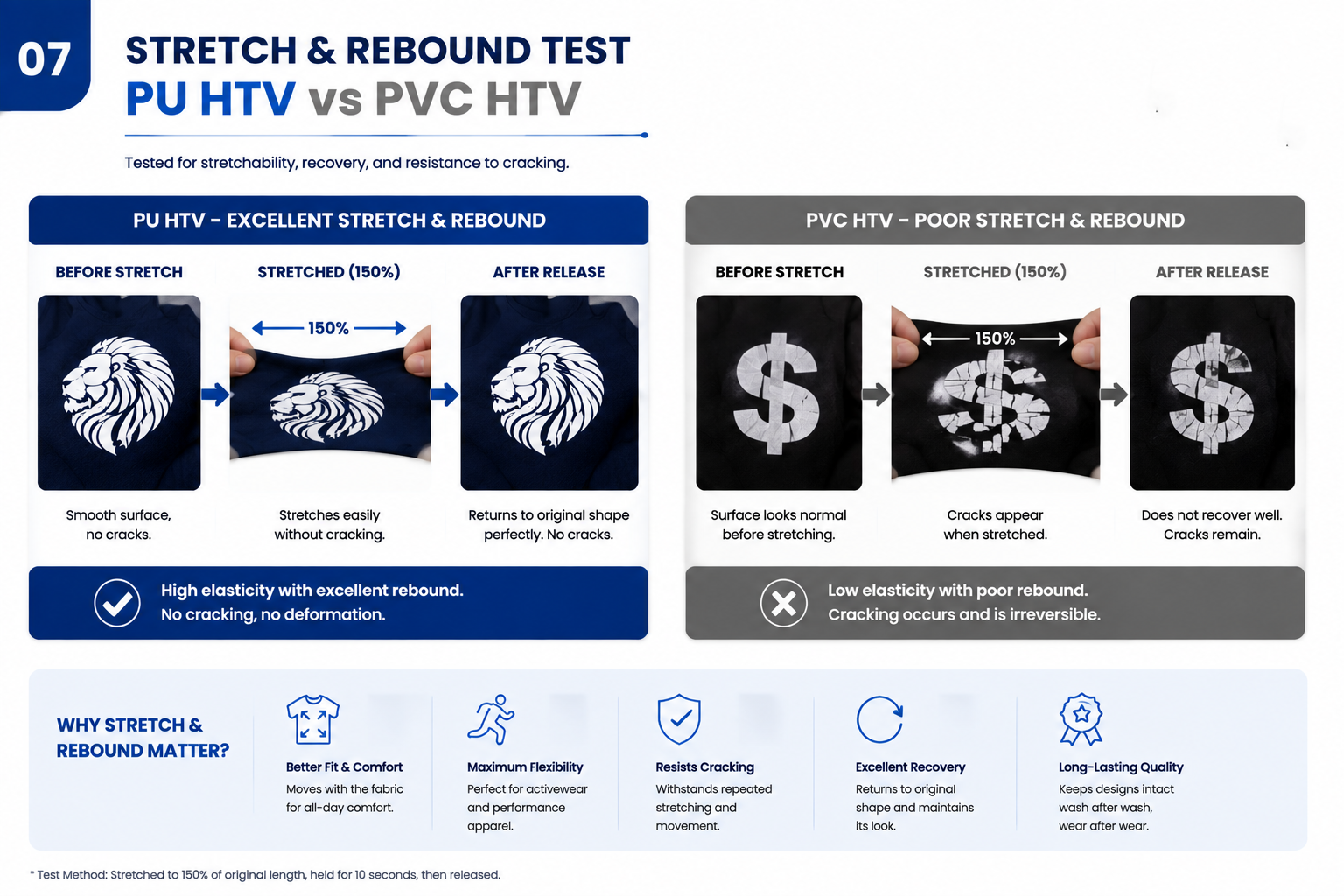
| Metric | PU HTV | PVC HTV |
| Elongation at break | >200% | <100% |
| Rebound rate | >95% | <70% |
| Cracking after 100 stretches | None | Cracking visible |
Conclusion: PU HTV is far superior for stretchable fabrics and activewear.
Test 3: Comfort (Blind User Testing)
| Metric | PU HTV | PVC HTV |
| Softness rating | 9.2/10 | 5.8/10 |
| Comfort against skin | 9.0/10 | 6.1/10 |
| Noticeability | “Barely felt” | “Clearly felt” |
Conclusion: Users overwhelmingly prefer the feel of PU HTV.
Test 4: Application Success Rate
| Metric | PU HTV | PVC HTV |
| First-time success | 95% | 82% |
| Common issues | Minimal | Burn marks, incomplete transfer |
| Repair rate | <2% | >8% |
Conclusion: PU HTV is more forgiving and has a higher first-time success rate.
Why Choose Koala® Factory’s PU Heat Transfer Vinyl
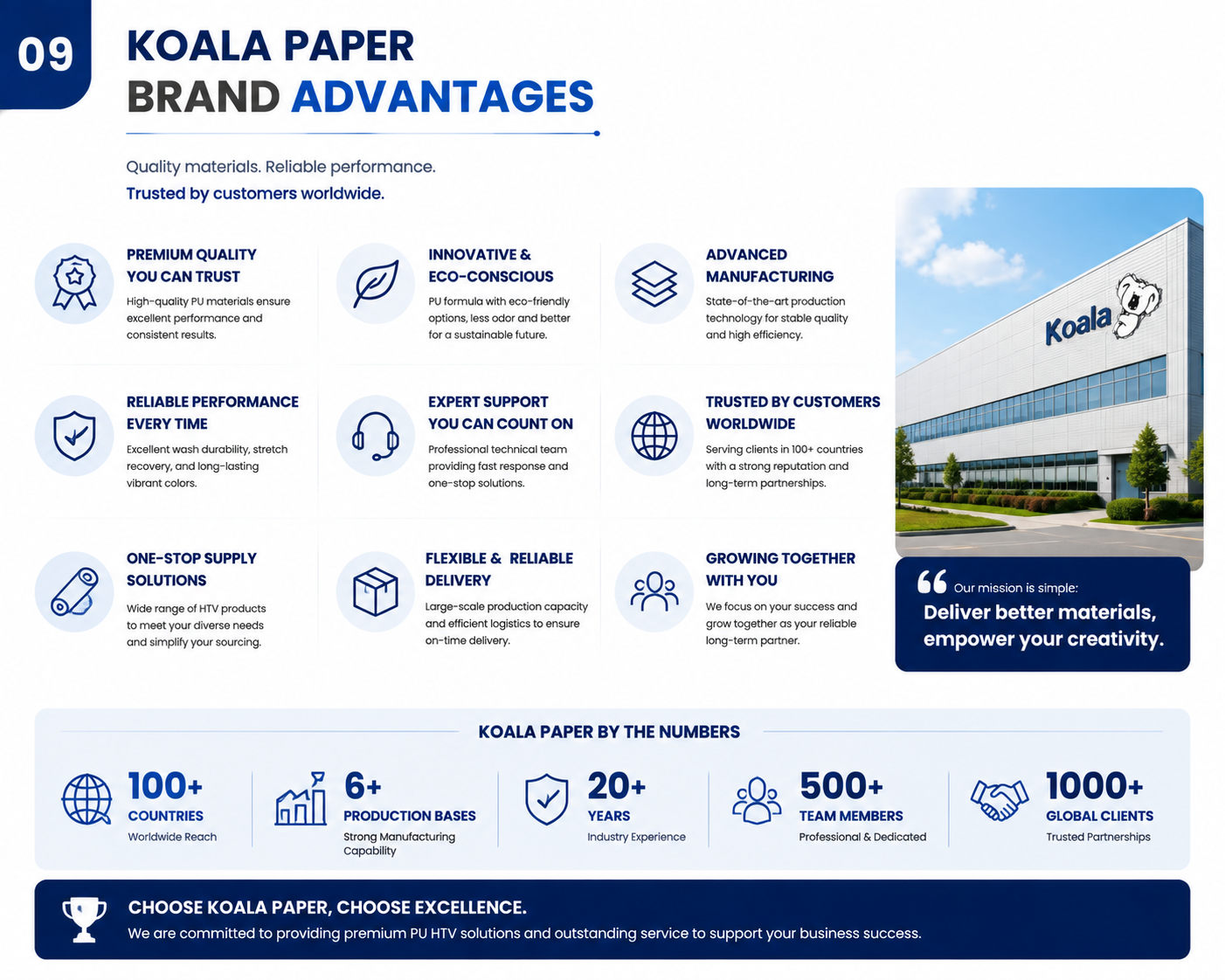
At Koala® factory, we exclusively produce PU heat transfer vinyl HTV because we firmly believe quality is paramount—especially for our clients whose core business is custom apparel.
Our PU Heat Transfer/Vinyl Advantages
1.Soft, Professional Texture
Our high-quality PU heat transfer vinyl boasts a soft, matte finish that blends seamlessly with garments. Customers can feel the difference and become repeat customers.
2.Superior Durability
Our PU material offers excellent resistance to fading, peeling, and cracking—the pattern remains vibrant and durable even after repeated washing.
3.Compatible with Cricut and Other Cutting Machines
Our PU heat transfer film is perfectly compatible with Cricut, Silhouette, and other household cutting machines. Easy to cut, remove excess, and transfer.
4.Factory Direct Prices
As a manufacturer with over 10 years of experience, we can offer highly competitive prices while maintaining quality.
5.Multiple Sizes and Colors
Available in multiple sizes (12 x 20 ft, 12 x 8 ft, and custom lengths) and colors (white, black, and custom colors).
6.Easy Peel Technology
Our PU heat transfer film features easy peel technology for quick and easy removal of excess vinyl material.
7.Strong Adhesion
Adheres firmly to fabric and remains durable even after repeated washing.
8.Vibrant Colors
Delivers bright, consistent colors that stand out on any fabric.
Customer Testimonials
"I used to use PVC heat transfer vinyl, but now I've switched to Koala® Paper's PU heat transfer vinyl for my sportswear line. The difference in quality is night and day. My customers love the soft touch, and I haven't received a single complaint about cracking."
—Mark, US Custom Sportswear Company
"Koala® Paper's PU HTV vinyl removes glue exceptionally well, leaving no flaws after each heat press. I tried other brands, but ultimately chose Koala® Paper."
—Sarah, UK Etsy Seller
"Initially, I was skeptical about the high price of PU, but after witnessing its durability firsthand, I'll never use PVC again. The 50+ wash guarantee truly lives up to its name."
—David, Australian Printing Shop Owner
Final Conclusion
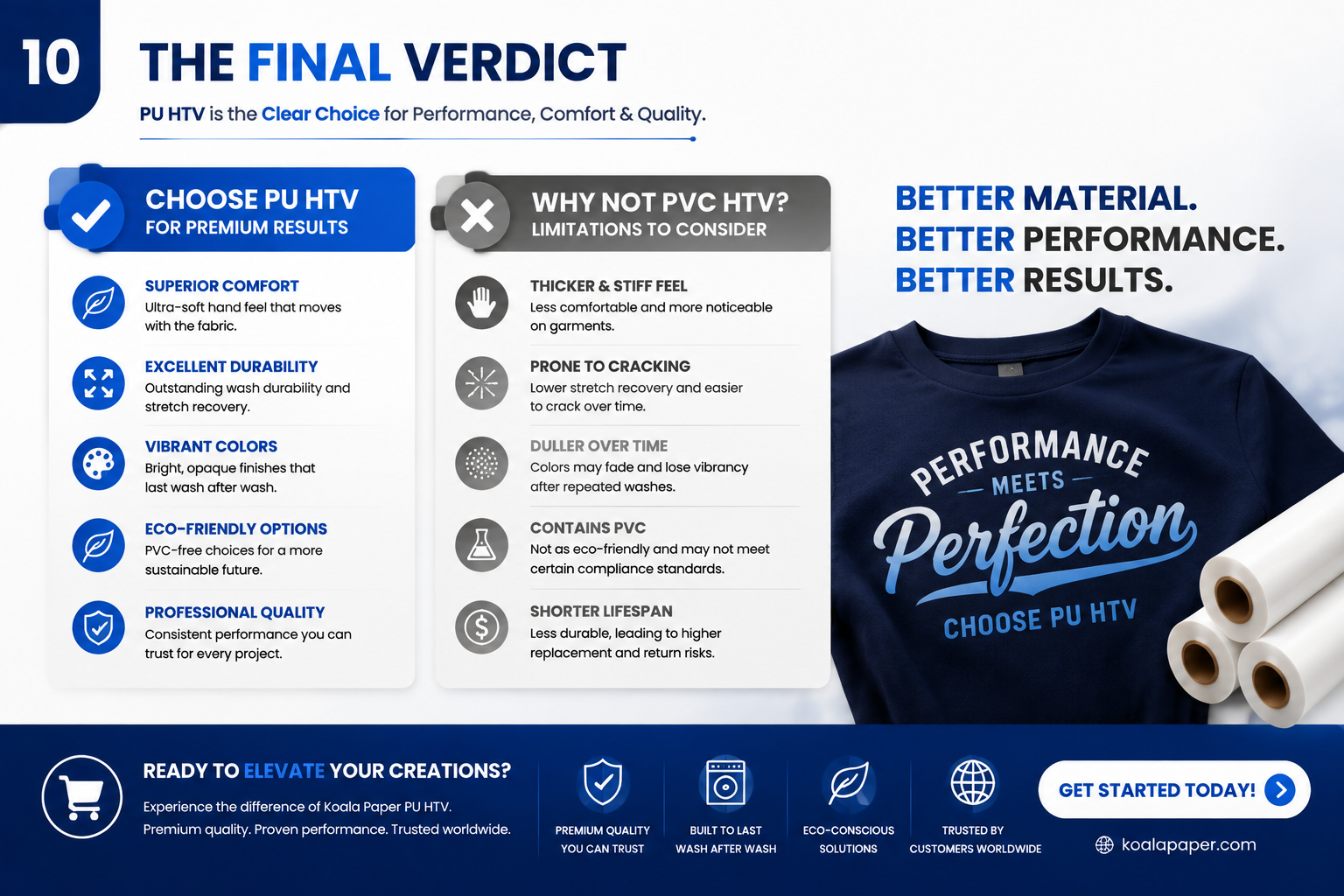
PU heat transfer vinyl for t-shirts is a premium choice. It's thinner, softer, more stretchy, and more durable than PVC. It blends seamlessly with the garment, stretches with the fabric, and is durable enough to withstand over 50 washes. If you're making products to sell, PU is a professional choice.
PVC HTV vinyl is an economical option. It's cheaper—about 30% less than PU. It's suitable for simple designs, larger lettering, and projects where cost is a primary consideration. However, it's thicker, slightly less comfortable, and more prone to cracking over time.
Why is PU HTV more expensive?
PU is a higher-performance material with better elasticity, softness, and durability. The raw material costs are higher, which translates to a higher retail price — typically about 30% more than PVC. However, the improved quality and durability often justify the additional cost.
How long does PU HTV last?
When properly applied, PU HTV lasts at least 50 washes without cracking, peeling, or significant fading. Many customers report designs lasting for years with proper care.
How long does PVC HTV last?
PVC HTV typically lasts 20–30 washes before showing signs of wear — cracking, peeling, or fading. This is adequate for short-term use but insufficient for products meant to last.
Can PU HTV be used on dark fabrics?
Yes. PU HTV provides excellent opacity and works on both light and dark fabrics. The high pigment loading ensures bright, vibrant colors even on black garments.
Is PU HTV safe for children‘s clothing?
Yes. PVC-free PU materials are certified and eco-friendly, making them safe for children‘s clothing. There is no risk of toxic chlorine gas release.
Can I use PU HTV with my Cricut?
Yes. Our PU HTV is fully compatible with Cricut, Silhouette, and other vinyl cutters. It cuts cleanly, weeds easily, and transfers consistently.
How does PU HTV compare to sublimation?
Sublimation works only on polyester and leaves no feel, but requires a dedicated printer. PU HTV works on cotton and is applied with a cutter and heat press — different tools for different needs. Sublimation is better for polyester and hard surfaces; PU HTV is better for cotton and stretch fabrics.
What care instructions should I provide for PU HTV garments?
- Wash inside out in cold water
- Use mild detergent (no bleach)
- Air dry or tumble dry low
- Do not iron directly on the design
- Do not dry clean