Introduction
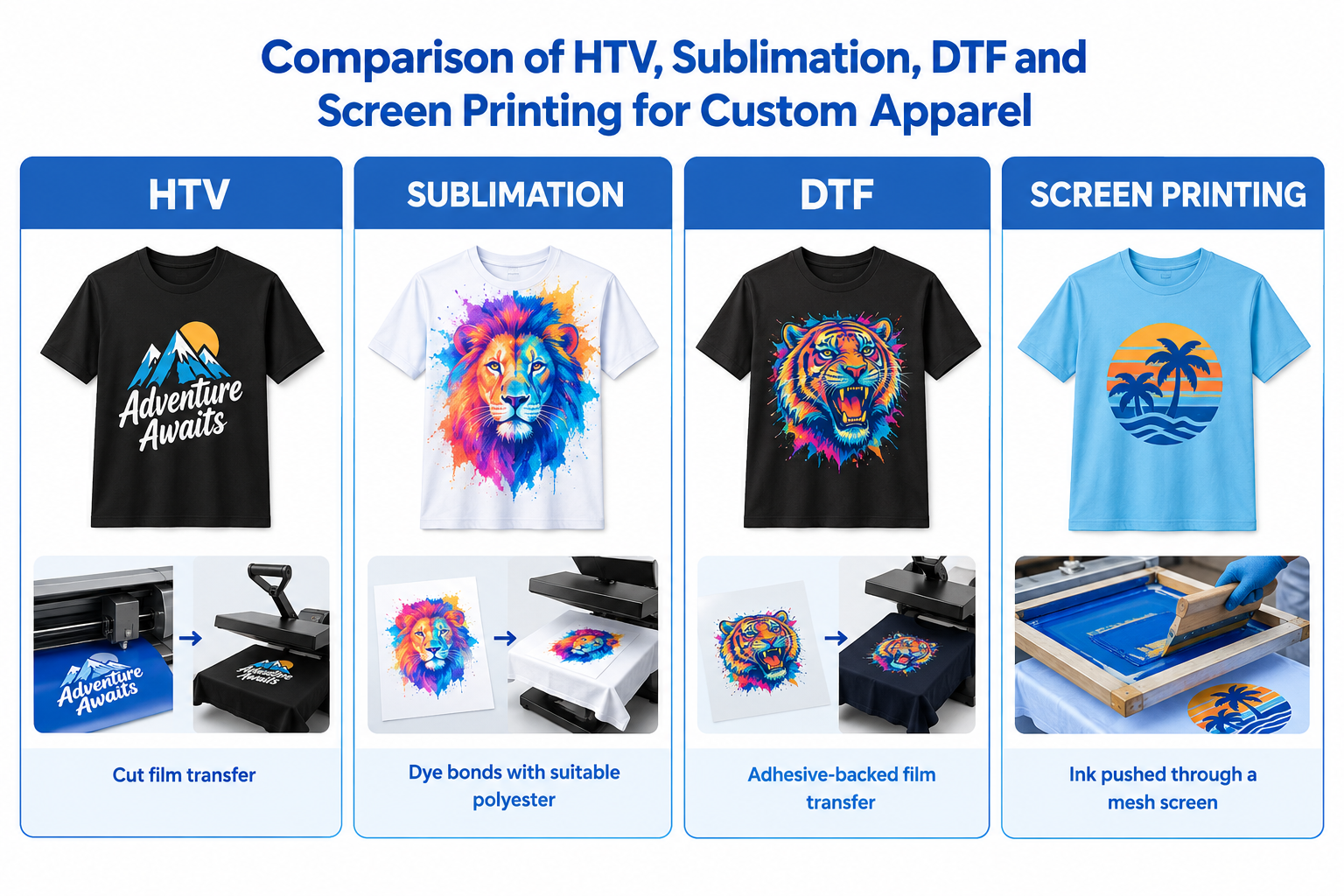
There is no single "best" method for custom T-shirt or apparel orders. Heat Transfer Vinyl (HTV), sublimation paper printing, Direct-to-Film (DTF), and screen printing each have their own strengths and are suited to different production requirements. The choice of method depends on factors such as fabric material, design, garment color, order volume, desired finish, and your existing equipment.
Heat Transfer Vinyl is often the practical choice for simple elements like names and numbers, or for achieving special textured effects. Sublimation offers distinct advantages for printing soft, seamless designs on white or light-colored polyester garments. DTF is highly versatile, capable of printing full-color designs on a wide range of fabric types and colors. Screen printing is highly competitive for repeat orders of the same design, particularly when the design involves a limited number of colors.
This guide compares these four methods across several dimensions—including workflow, suitability, hand-feel, cost structure, durability, and production scale—to help you make the right choice for your specific project needs.
Quick Answer: Which Printing Method Should You Choose?
| If your priority is… | Start by considering | Why |
| Names, numbers, simple shapes, or specialty effects | HTV | Cut film is practical for straightforward artwork and effects such as glitter or metallic finishes, depending on the film. |
| A soft finish on white/light polyester | Sublimation | Dye bonds with suitable polyester fibers or polymer-coated substrates instead of leaving a typical transfer layer. |
| Full-color artwork on cotton, blends, or dark garments | DTF | DTF transfers can reproduce detailed, multicolor designs on a broad range of apparel when correctly specified and applied. |
| A large repeat order with a limited-color design | Screen printing | Setup takes effort, but the setup cost can be spread across many pieces. |
| One-off orders with changing designs | HTV or DTF | Neither process requires making a new screen for every design; choose based on artwork complexity and workflow. |
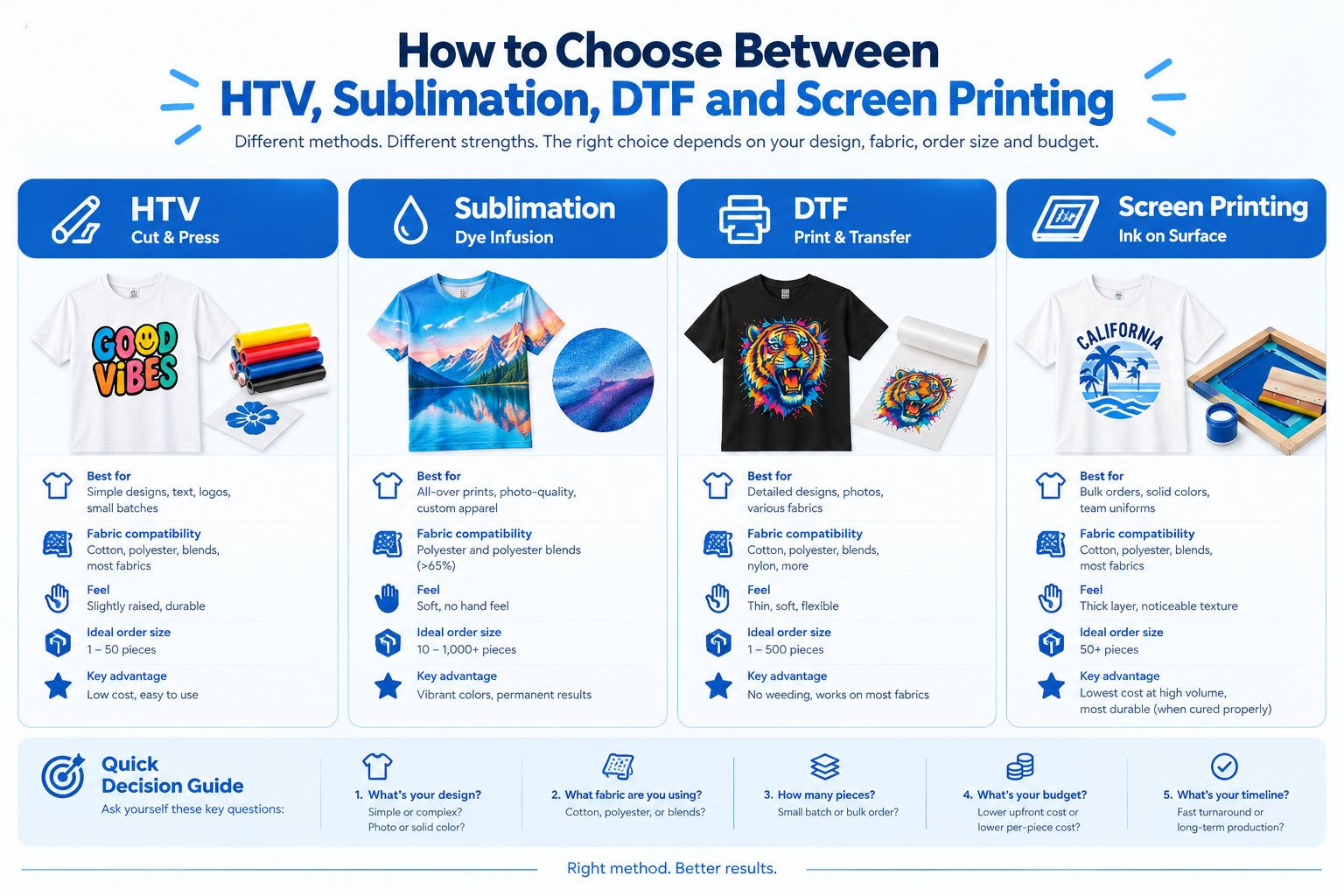
These are starting points, not guarantees. Product construction, fabric finish, press settings, ink and adhesive systems, operator skill, and quality-control requirements can change the result.
The Core Difference: Where Does the Color Go?
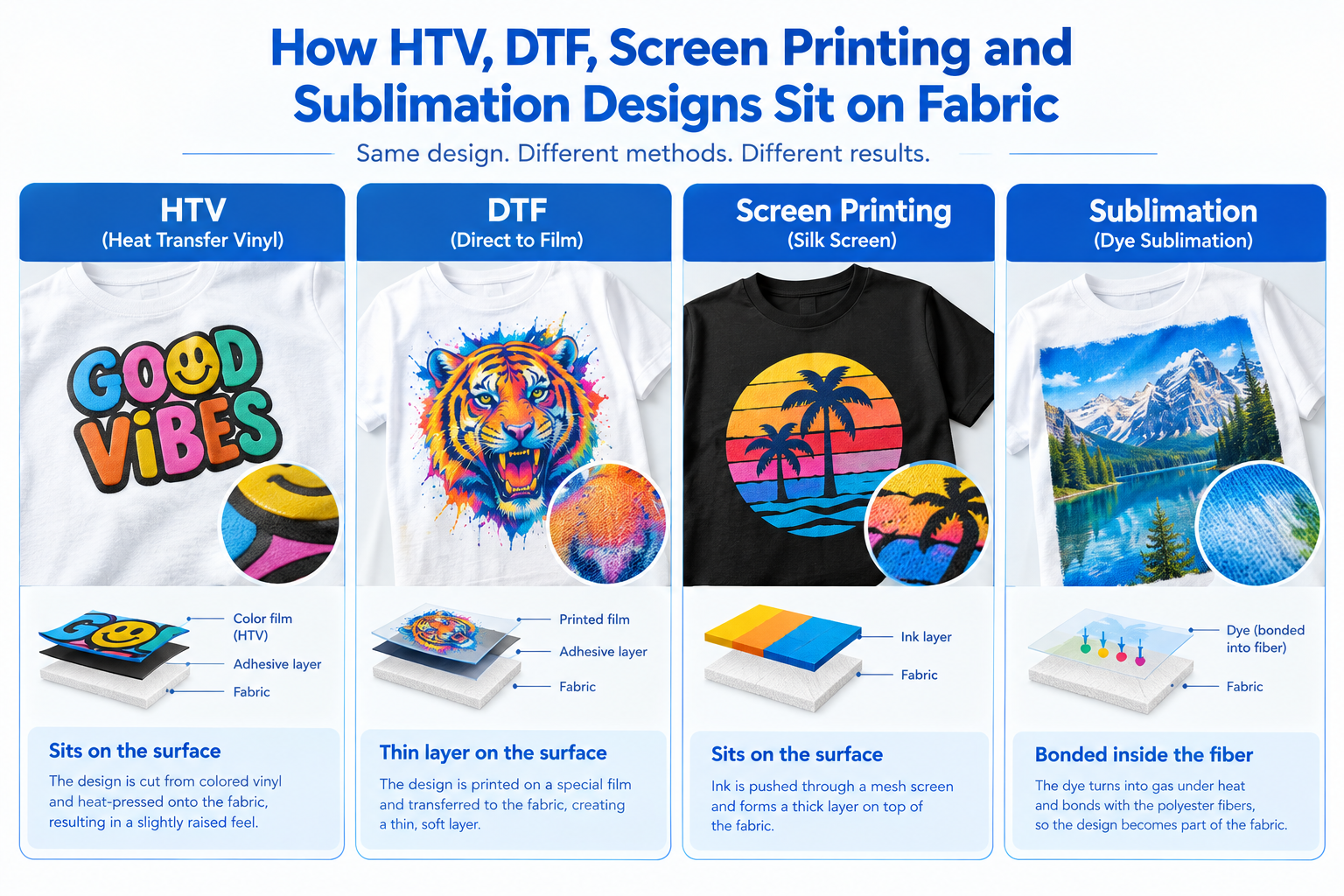
The most useful first distinction is how each method creates the image on the garment:
| Method | How the design is applied | Typical hand feel | Main constraint |
| HTV | A colored or specialty film is cut, weeded, and heat-applied to the garment. | Often raised or film-like; depends on film type and layering. | Intricate, multicolor artwork can take longer to cut, weed, and layer. |
| Sublimation | Heat turns disperse dye into gas so it bonds with suitable polyester fibers or polymer-coated surfaces. | No separate transfer layer on correctly sublimated polyester. | Best on white/light polyester or compatible polymer-coated products; no white ink. |
| DTF | Artwork is printed onto a transfer film, combined with adhesive, cured, then heat-applied. | A transfer layer is present; thickness and softness vary by system and design coverage. | Requires compatible printing, powder/adhesive, curing, and pressing workflow. |
| Screen printing | Ink is pushed through a mesh screen onto the garment and cured. | Varies by ink, deposit, and print coverage; can be noticeable. | Screens and setup are required for each design/color configuration. |
1. Heat Transfer Vinyl (HTV)
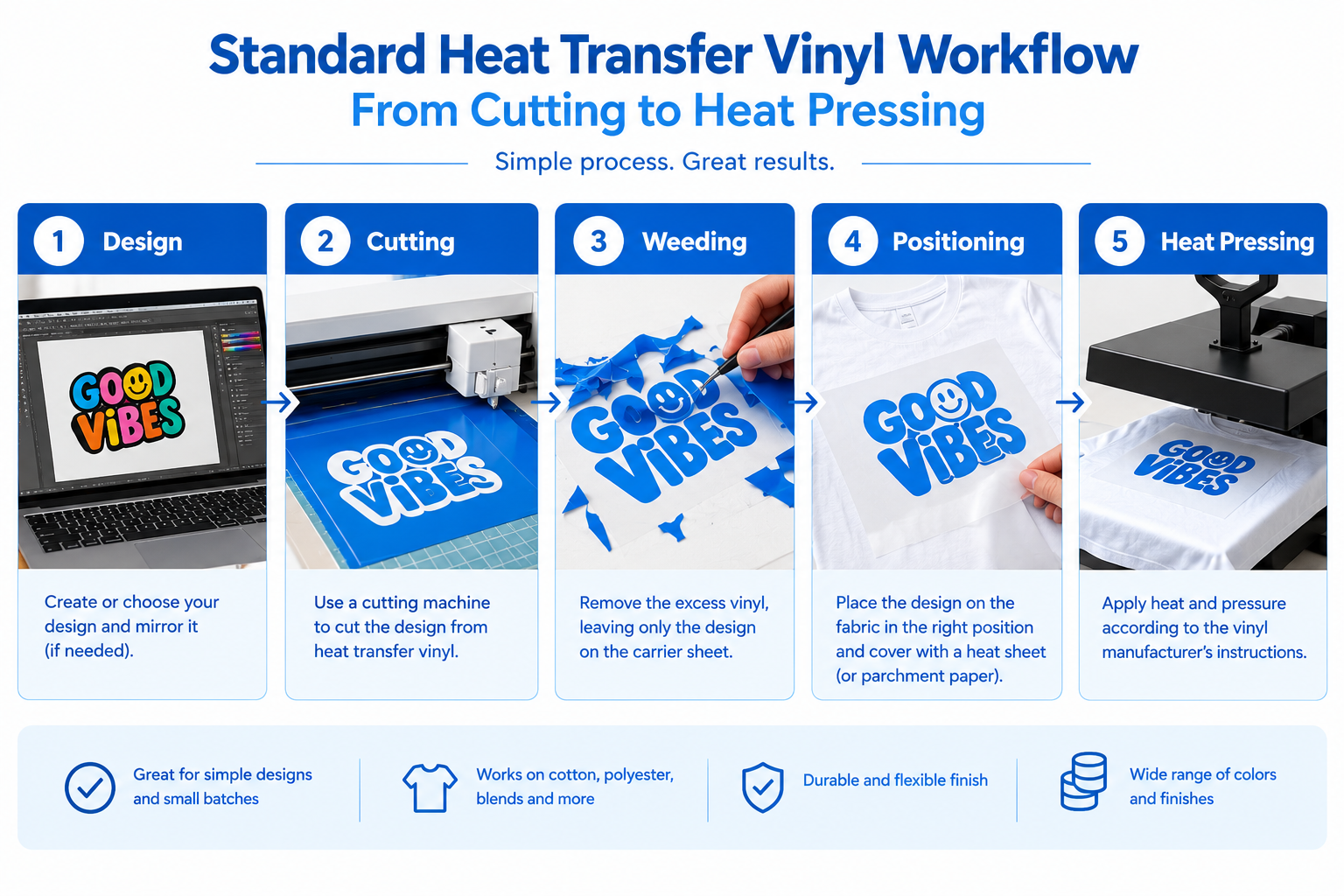
HTV is a film-based decoration method. A design is cut from heat transfer vinyl, excess material is weeded away, and the remaining design is applied with heat and pressure. A vinyl cutter and heat press are common tools, although some hobbyists begin with a household iron; a press generally provides more consistent pressure and temperature.
When HTV makes sense
- Names, numbers, short text, logos, and simple shapes.
- Personalized garments, uniforms, small batches, and on-demand work.
- Specialty finishes such as glitter, flock, metallic, or holographic effects when a suitable HTV product is available.
Trade-offs to consider
- Detailed artwork can be time-consuming to weed.
- Multicolor designs may require layering and careful alignment.
- The film layer may be noticeable, especially with large designs or multiple layers.
HTV performance is product-specific. Do not assume every PU or PVC film has the same stretch, wash resistance, temperature, dwell time, or peel instructions. Follow the technical sheet for the exact product and test on the intended garment.
2. Dye Sublimation
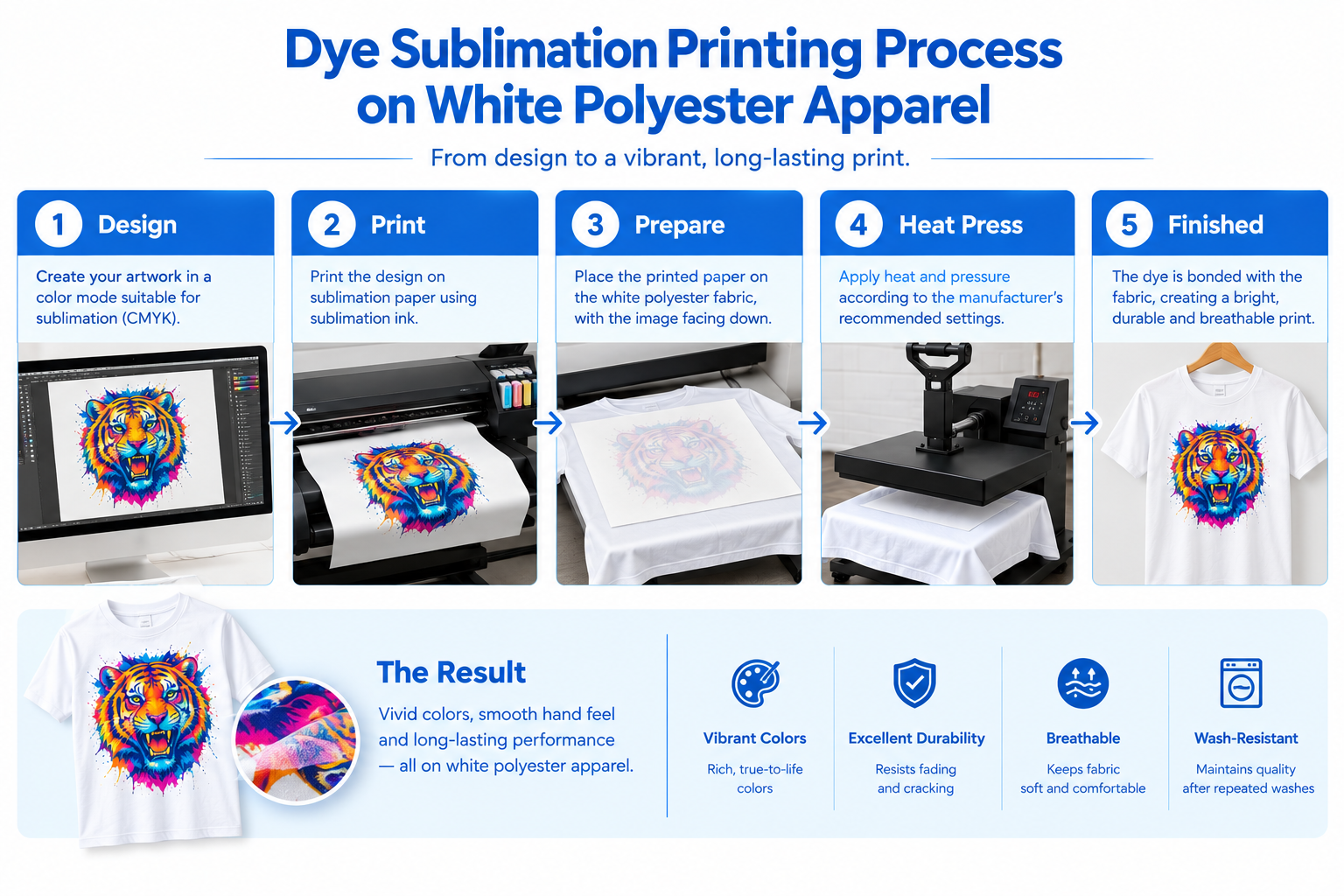
Dye sublimation uses disperse dye and heat to transfer color into suitable polyester fibers or polymer-coated substrates. On compatible polyester fabric, the design becomes part of the fiber structure rather than sitting as a separate film layer. This is why sublimated garments typically have no added print texture.
When sublimation makes sense
- White or light-colored polyester sportswear, jerseys, performance apparel, and all-over designs.
- Products with a compatible polymer coating, such as certain mugs, panels, and promotional blanks.
- Full-color graphics where a soft, no-added-layer finish is important.
Important limitations
- Standard sublimation is not a direct solution for untreated 100% cotton because the dye does not bond to cotton fibers the way it does to polyester.
- Sublimation inks are generally translucent and do not print white; dark substrates therefore do not reproduce colors as expected.
- Polyester blends can produce less vivid or heathered-looking results because the dye colors the polyester component, not the cotton fibers.
Check the substrate manufacturer's requirements. Polyester percentage alone does not guarantee a particular result: fabric construction, color, coating, ink, transfer paper, temperature, pressure, and time all matter.
3. Direct-to-Film (DTF)
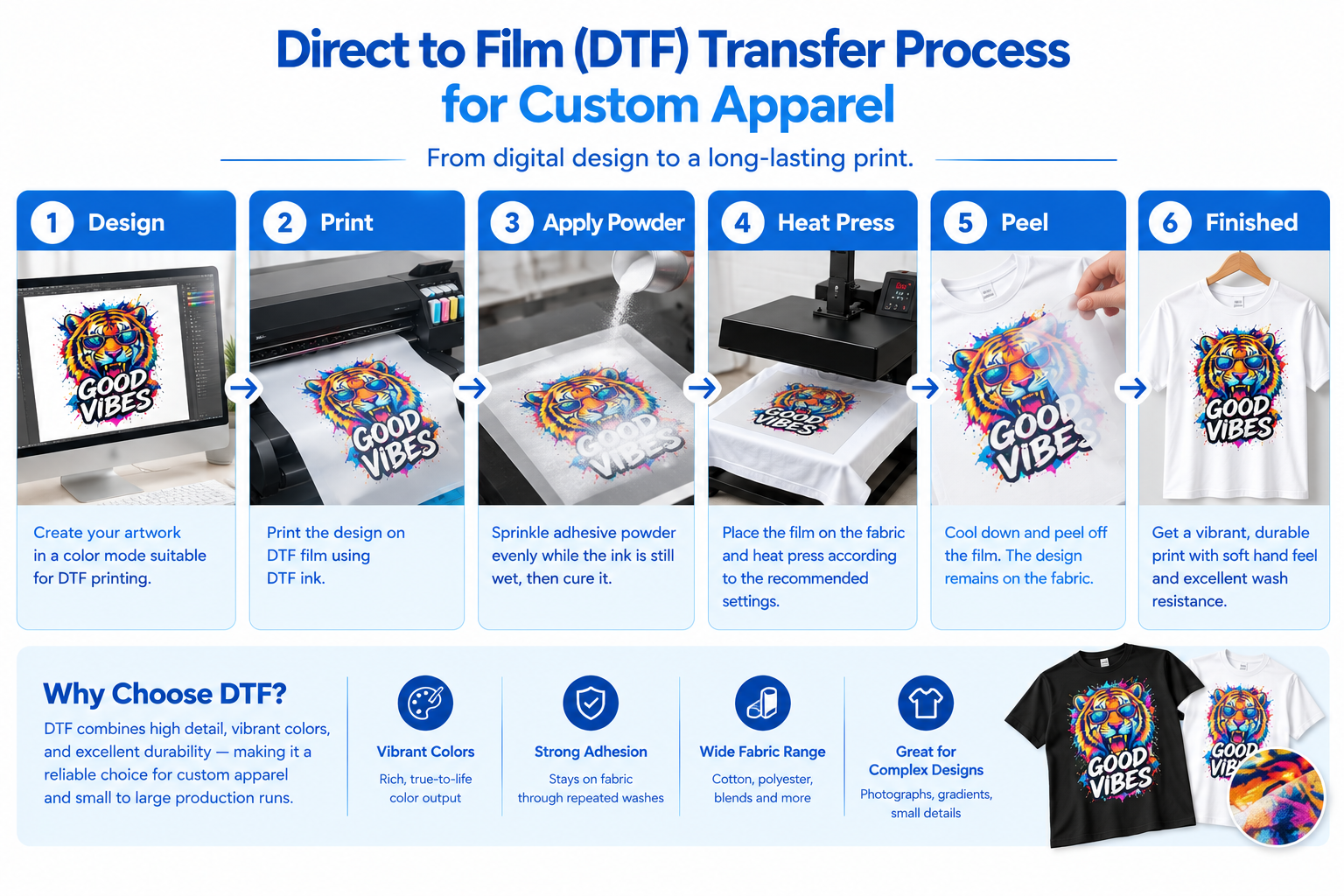
DTF printing creates the artwork on a dedicated transfer film. The print is combined with a compatible hot-melt adhesive, cured according to the system requirements, and heat-pressed onto the garment. DTF Printing is popular for detailed, full-color artwork because the design does not need to be separated into individual cut vinyl layers or screens.
When DTF makes sense
- Full-color illustrations, gradients, and photographic artwork.
- Orders spanning cotton, polyester, blends, and dark garments, subject to transfer and fabric compatibility.
- Mixed orders where artwork changes frequently and there is no single large run of one design.
Trade-offs to consider
- Production requires a compatible printer and ink, film, adhesive powder, curing process, and heat press—or a reliable transfer supplier.
- The transfer creates a layer on the garment; hand feel depends on ink coverage, transfer construction, and application.
- Curing, humidity, storage, pressing, and post-press instructions can affect transfer quality.
Do not treat a single DTF temperature/time recipe as universal. Use the transfer supplier's application instructions and validate them on the actual garment.
4. Screen Printing
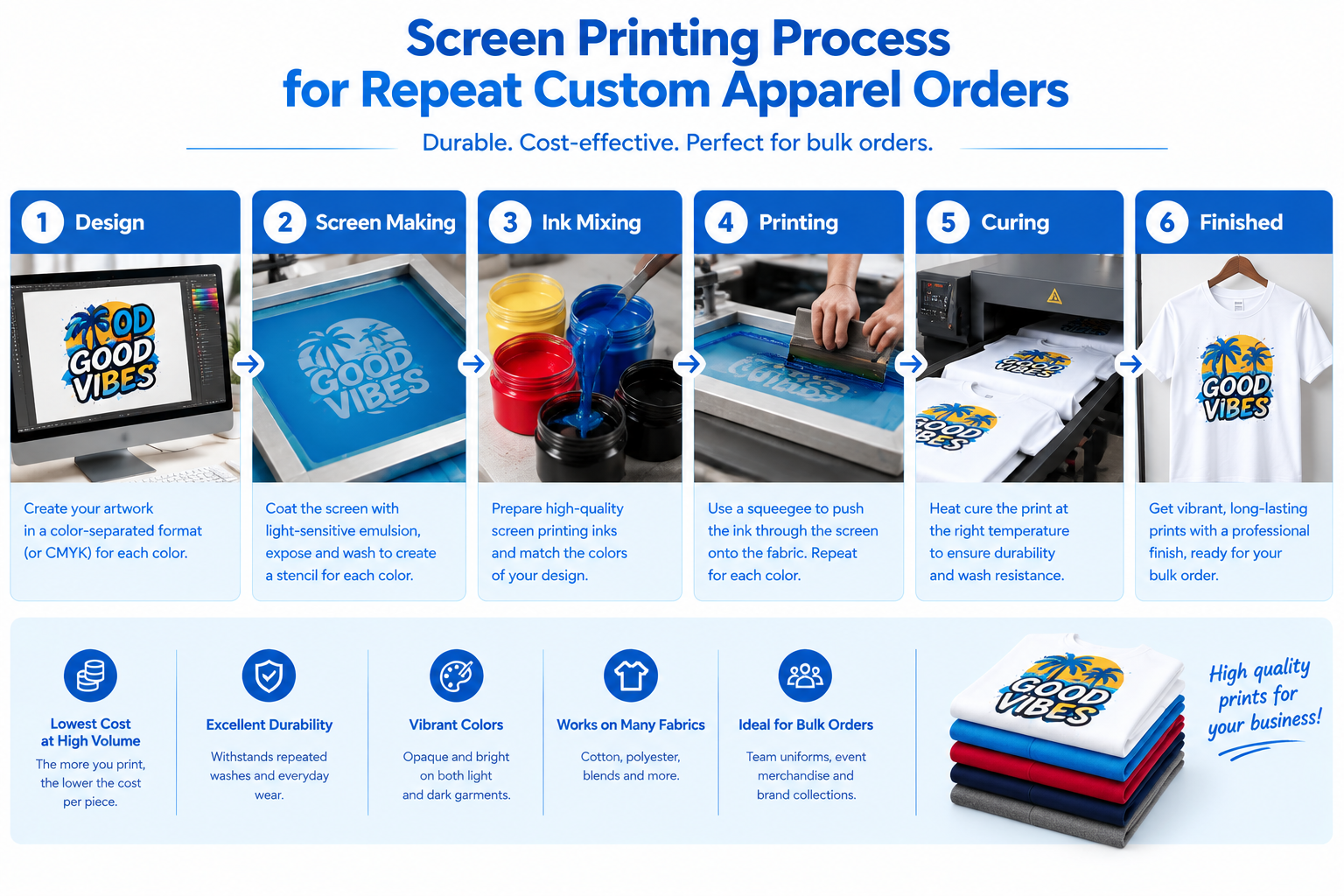
Screen printing pushes ink through a mesh screen onto the garment. A separate screen is typically prepared for each color in the design, followed by the appropriate curing process. This setup makes screen printing less convenient for constantly changing one-off designs, but it can become cost-effective when many pieces share the same artwork.
When screen printing makes sense
- Repeat orders with consistent artwork and a limited color count.
- Team apparel, event shirts, merchandise, and production runs where setup can be spread across many garments.
- Projects that need a specified ink system or print effect available through the screen printer.
Trade-offs to consider
- Screen preparation, color separations, registration, and cleanup add setup work.
- More colors or frequent artwork changes can increase setup complexity and cost.
- The final hand feel and durability depend on the ink system, deposit, curing, fabric, and quality control.
Screen printing is not automatically the cheapest option for every order over a fixed number of pieces. The break-even point depends on setup charges, number of colors, garment cost, labor, print size, and the quote from the production shop.
Side-by-Side Comparison
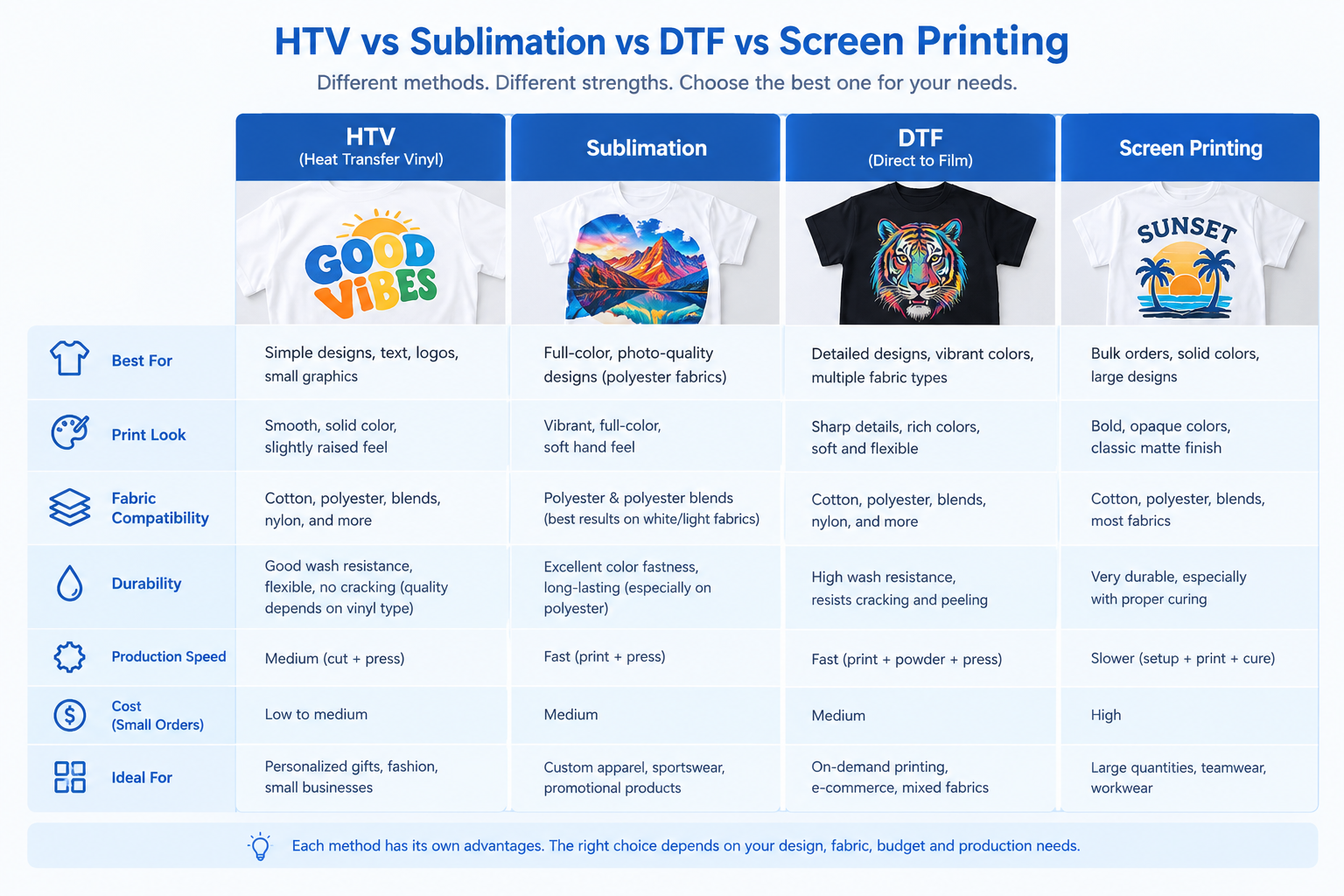
| Factor | HTV | Sublimation | DTF | Screen printing |
| Best artwork fit | Text, numbers, simple shapes, specialty effects | Full-color artwork on compatible light polyester | Detailed full-color artwork across many garment types | Repeat designs, especially limited-color artwork |
| Cotton | Generally yes, if HTV is specified for the fabric | Not directly on untreated cotton | Often suitable with a compatible transfer | Often suitable with compatible ink and process |
| Dark garments | Many opaque HTV products work; verify product | Usually unsuitable for bright results because there is no white ink | Can work with suitable white-ink transfer system | Can work with suitable ink and underbase strategy |
| Print feel | Film-like; depends on material and coverage | No separate layer on suitable polyester | Transfer layer; depends on coverage and construction | Varies by ink, deposit, and design |
| Design changeover | New cut file and weeding | New print file and transfer | New print file/transfer | New setup/screens as required |
| Setup investment | Often lower entry cost | Printer, sublimation ink, press, and compatible blanks | Higher if producing transfers in-house; lower if outsourcing transfers | Depends on whether printing in-house or outsourcing |
| Cost behavior | Material and labor rise with design complexity | Consumables and equipment; substrate restrictions matter | Transfer cost and workflow often scale with artwork size and production route | Setup costs spread across repeat quantity |
| Key caution | Weeding, layering, and product-specific settings | Substrate color and polymer compatibility | Transfer quality and application control | Setup, registration, and curing |
Use this table to shortlist methods. For a purchasing decision, compare actual quotes using the same garment, print dimensions, color requirements, packaging, turnaround, and quality standard.
How to Choose by Order Quantity
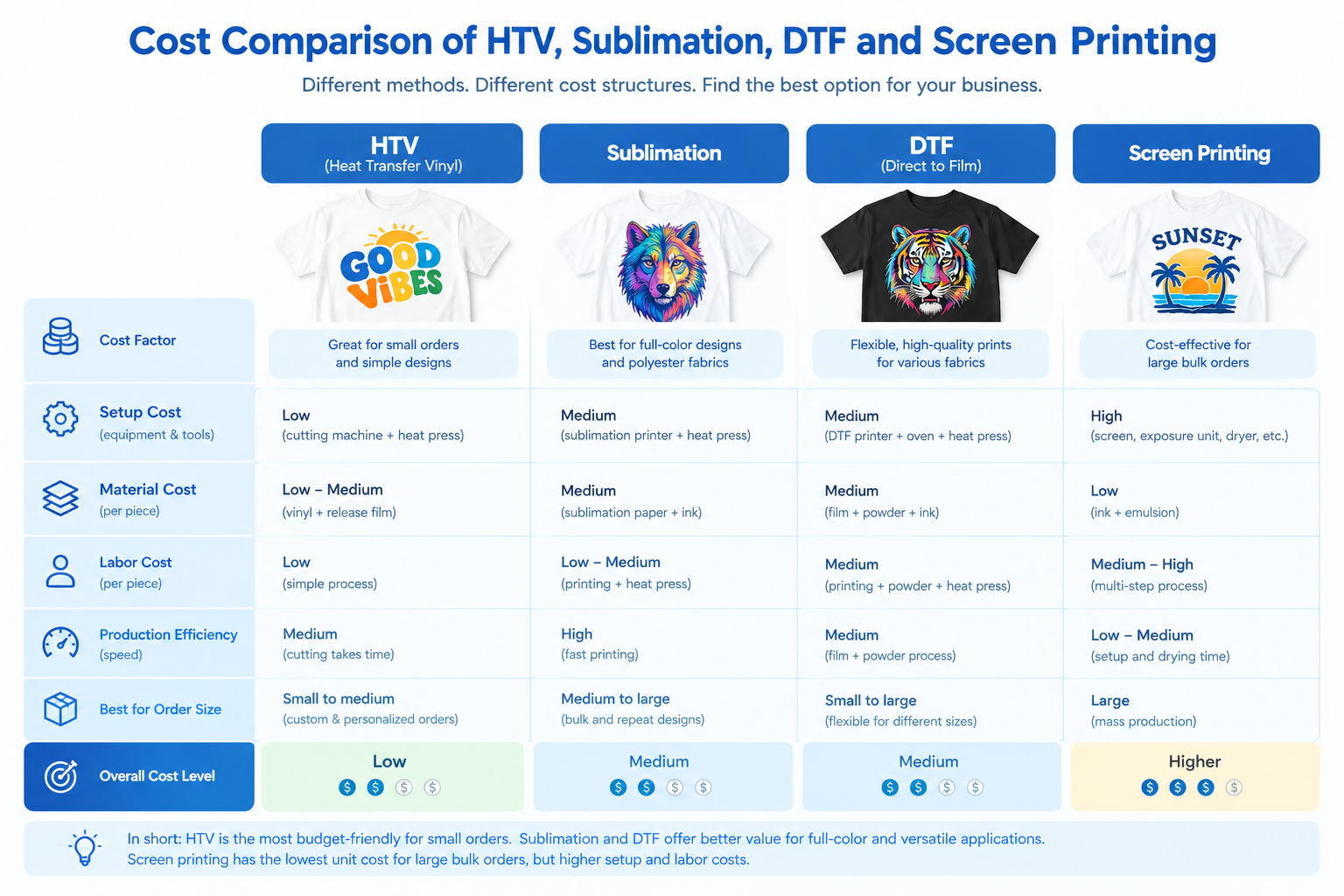
Quantity matters, but it should not be the only decision rule. Compare the total job cost rather than material cost alone.
| Order situation | Methods to quote first | What to compare |
| One-off or personalized item | HTV or DTF; sublimation for compatible polyester | Design complexity, labor time, setup, and equipment access |
| Small batch with varied artwork | HTV or DTF; sublimation for suitable substrates | Time per design, transfer cost, color detail, and changeover |
| Repeat run of one simple design | Screen printing and HTV/DTF as alternatives | Setup fee, color count, print size, garment count, and reorder cost |
| Large run of full-color artwork | Screen printing versus DTF; sublimation if polyester-compatible | Actual quote, artwork limitations, fabric, and expected reorder volume |
A useful costing formula is: total job cost = setup + materials/consumables + garment cost + direct labor + waste/rework + finishing/packaging. Divide by the number of acceptable finished pieces to estimate cost per sellable unit.
Before publishing specific dollar figures, collect current quotes from your target market and state the date, currency, order quantity, print size, number of colors, and whether labor and garments are included. Avoid presenting equipment prices or per-shirt estimates as universal industry averages.
How to Choose by Fabric and Garment Color
| Garment / substrate | Methods to consider | Notes |
| White or light 100% polyester | Sublimation, DTF, HTV, screen printing | Sublimation is especially attractive when a no-added-layer finish is desired. |
| 100% cotton | HTV, DTF, screen printing | Standard dye sublimation does not directly bond to untreated cotton. |
| Cotton/polyester blend | HTV, DTF, screen printing; sublimation with realistic expectations | Sublimation colors only the polyester component, so appearance can be muted or textured. |
| Dark cotton or dark blends | Opaque HTV, suitable DTF, screen printing | Standard sublimation cannot add white ink to make bright artwork visible on dark fabric. |
| Polymer-coated hard goods | Sublimation if the blank is explicitly compatible | The coating and transfer settings must be suitable for sublimation. |